
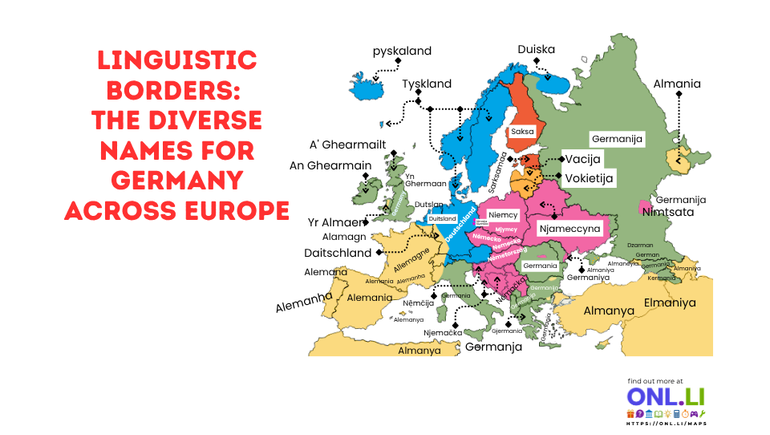
Germany may be one country on a political map, but across Europe, its name changes dramatically from language to language. The image shows how different communities call Germany by names that often come from old tribes, neighboring peoples, historical contact, or borrowed forms passed through other languages.
These names are more than translations. They are small clues about how Europeans have seen, traded with, fought against, lived beside, and described German-speaking peoples over many centuries.
Why Germany Has So Many Names
Most countries have slightly different names in different languages. Germany is unusual because its names vary so widely. In English it is “Germany.” In German, it is “Deutschland.” In French, it is “Allemagne.” In Polish, it is “Niemcy.” In Finnish, it is “Saksa.”
These names do not come from one shared root. Instead, they come from several older sources. Some refer to ancient Germanic tribes. Others describe outsiders or neighbors. Some reflect Latin influence, while others preserve local medieval terms.
That is why the map looks like a patchwork of language families and historical memories rather than a simple translation chart.
The “Germany” Family: A Latin Legacy
The English word “Germany” comes from the Latin Germania, a term used by the Romans for lands and peoples east of the Rhine River. This Roman label became influential because Latin shaped scholarship, religion, diplomacy, and mapmaking across Europe for centuries.
Languages that use forms related to “Germany” often inherited or adapted this Latin tradition. You can see versions such as “Germanija,” “Germaniya,” and similar forms across parts of Eastern and Southeastern Europe.
This name reflects how powerful Roman geography remained, even long after the Roman Empire itself had changed or disappeared.
The “Deutschland” Family: The People’s Language
In German, the country is called Deutschland. This comes from an old word connected to “the people” or “the popular language.” In simple terms, it referred to the language spoken by ordinary people, as opposed to Latin, which was used in church, education, and official writing.
The root also appears in languages close to German or influenced by it. Dutch uses Duitsland, while some neighboring languages use related forms.
This name is important because it is the country’s own name for itself. It is not based on what outsiders called German-speaking people. It comes from an internal linguistic identity.
The “Allemagne” Family: The Alemanni Connection
French uses Allemagne, Spanish uses Alemania, Portuguese uses Alemanha, and several other languages have similar versions. These names come from the Alemanni, a confederation of Germanic peoples who lived near areas that later bordered France and Switzerland.
For speakers in western Europe, the Alemanni were among the most visible Germanic neighbors. Over time, the name of one group came to stand for a much larger German-speaking region.
This is a common pattern in history. A neighboring people may become the name for an entire country, even when that group represents only one part of a larger population.
The “Saksa” Family: Germany Through the Saxons
In Finnish, Germany is Saksa. In Estonian, it is also related to the Saxons. This name comes from the Saxons, another Germanic people who were historically important in northern Europe.
For communities around the Baltic region, contact with Saxons and northern German traders helped shape how Germany was named. The name reflects geography and trade routes as much as ethnicity.
This is a reminder that language often records the first or strongest contact between peoples. A group known through commerce, settlement, or political power can leave its name behind for centuries.
The “Niemcy” Family: The Silent or Unintelligible People
In Polish, Germany is Niemcy. Similar forms appear in several Slavic languages. This word is often linked to an old Slavic root meaning something like “mute” or “unable to speak,” referring not to literal silence, but to people whose language was not understood.
From a Slavic-speaking perspective, Germanic neighbors spoke a language that was unfamiliar. The name developed from that linguistic boundary.
This may sound blunt today, but it reflects a common historical habit: people often named outsiders based on whether they could understand them. Language difference became a marker of identity.
Borders on the Map Are Not Just Political
The image is interesting because it shows that linguistic borders do not always match modern national borders. A political map tells us where Germany begins and ends today. A language map tells us how different regions have understood Germany through their own histories.
France and Spain preserve the memory of the Alemanni. Finland and Estonia preserve the memory of the Saxons. Poland and other Slavic languages preserve a word shaped by linguistic difference. English keeps a Latin-based name. German uses a native name connected to people and language.
Each term is a small historical archive.
What These Names Reveal About Europe
The many names for Germany show how connected Europe has always been. Even before modern borders, passports, and nation-states, communities were aware of one another. They traded, migrated, fought, converted, married, and borrowed words.
Names survived these encounters. Some names came from ancient tribes. Some came from Roman writers. Some came from neighbors trying to describe unfamiliar speech. Over time, these labels became normal country names.
This makes Germany a useful example of how language preserves older layers of European history.
Why the Map Is So Fascinating
At first glance, the map seems playful because it shows so many different words for one country. But it also points to something deeper: names are not neutral. They carry memory.
The word a language uses for Germany may reveal which Germanic group its speakers encountered first, which empire influenced its writing, which neighbors mattered most, or which historical relationship shaped its vocabulary.
That is why a simple country name can open a larger story about migration, geography, identity, and cultural contact.
Final Thoughts
Germany’s many names across Europe show that language is shaped by history as much as grammar. Germany, Deutschland, Allemagne, Saksa, and Niemcy all point to the same modern country, but they arrive there through very different paths.
The map reminds us that Europe is not only divided by borders on the ground. It is also divided, connected, and remembered through words. Each name for Germany tells us something about who was speaking, who they met, and how those encounters became part of everyday language.