
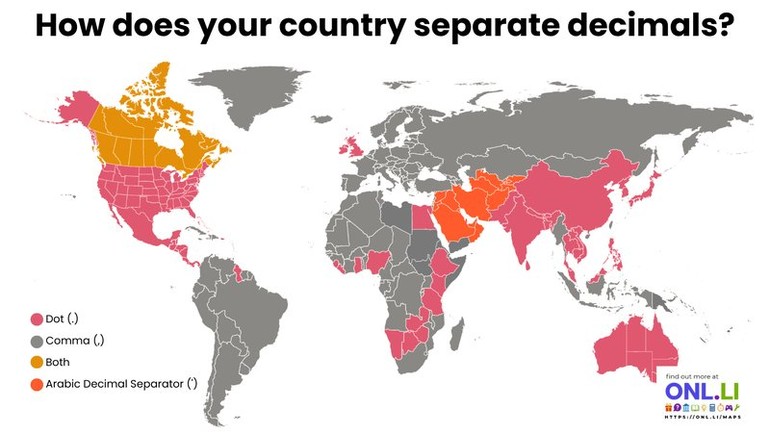
The way we write numbers is something most people never think about—until they encounter a different system abroad. This map highlights one of those small but surprisingly important differences: the symbol countries use to separate whole numbers from decimal values. While a period (.) and a comma (,) may seem interchangeable at first glance, they can completely change how a number is interpreted in finance, science, engineering, and everyday life.
Much of North America, the United Kingdom, Australia, and large parts of Asia use the decimal point, writing numbers like 3.14. Meanwhile, most of continental Europe, South America, and many African countries prefer the decimal comma, so the same number appears as 3,14. Canada officially recognizes both systems due to its English- and French-speaking populations, while several Middle Eastern countries use the Arabic decimal separator (٫) as part of the Arabic numeral system.
These differences are more than a matter of style—they're built into national standards, educational systems, and computer software. That's why international spreadsheets, financial reports, and scientific data often need formatting adjustments to avoid costly misunderstandings. A number written as 1,234 may represent one thousand two hundred thirty-four in one country, but one point two three four in another.
One interesting example is Canada, where both decimal styles are widely accepted depending on language and region. English-language documents typically follow the same conventions as the United States, while French-language publications generally use the European-style decimal comma, making Canada one of the few countries where both formats coexist officially.