
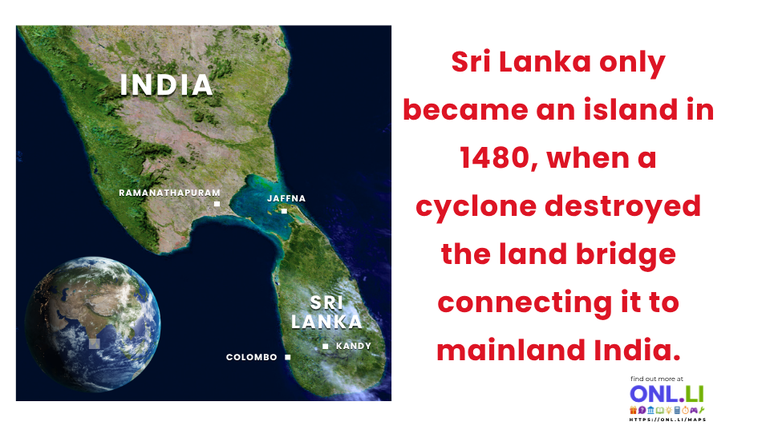
The map highlights one of the most fascinating geographic links in South Asia: the shallow chain of shoals between India and Sri Lanka known as Adam’s Bridge, Rama Setu, or Ram’s Bridge.
A Close Connection Across Shallow Water
Today, Sri Lanka is clearly an island nation. It sits southeast of India, separated by the Palk Strait and the Gulf of Mannar. But the water between the two countries is surprisingly shallow in places.
Beneath the surface lies a natural chain of sandbanks, reefs, and limestone shoals stretching between India’s Pamban Island and Sri Lanka’s Mannar Island.
The Story of the 1480 Cyclone
For centuries, this area was believed to have formed a passable connection between the two lands. Some accounts say that a powerful cyclone around 1480 damaged the remaining land bridge, making it impossible to cross on foot.
That dramatic event helped turn Adam’s Bridge into a subject of history, geography, religion, and legend.
A Place Filled with Cultural Meaning
In Hindu tradition, the formation is often called Rama Setu and is associated with the epic Ramayana. In Islamic tradition, the name Adam’s Bridge is tied to stories connected with Adam’s Peak in Sri Lanka.
These layers of meaning have made the area culturally important far beyond its physical size.
The Geology Behind the Story
Geologically, the story is more complex than a single storm. Sea levels, sediment movement, coral growth, and coastal erosion all played roles in shaping the region over thousands of years.
The 1480 cyclone may have worsened the gaps in the chain, but the separation between India and Sri Lanka developed through a much longer natural process.
What makes this so striking is how close the two places remain. On a map, the distance looks small. In reality, that narrow stretch of water has shaped trade, travel, migration, mythology, and politics for generations.
Sri Lanka may be an island today, but Adam’s Bridge reminds us that geography is rarely fixed forever. Land shifts. Seas rise. Storms reshape coastlines. And sometimes, a thin line of sand and stone can carry thousands of years of history.