

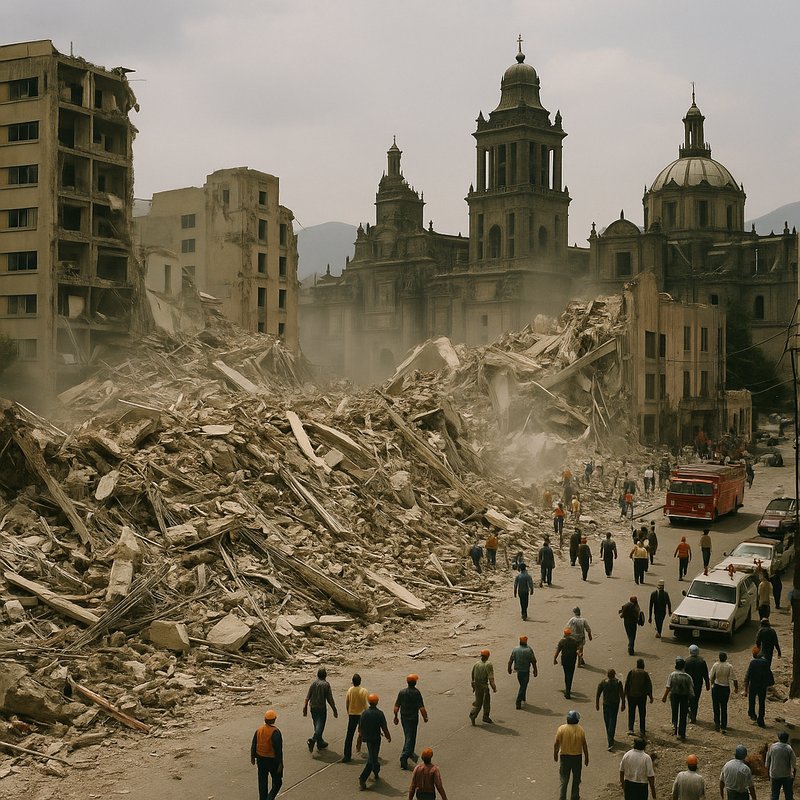
On September 19, 1985, a magnitude 8.0–8.1 earthquake struck off Mexico's Pacific coast, sending shockwaves hundreds of miles to devastate Mexico City. The city's ancient lakebed soil amplified and prolonged the shaking, collapsing roughly 412 buildings and killing thousands. Older, poorly constructed structures failed first, while entire neighborhoods suffered catastrophic damage. The disaster injured around 30,000 people and left up to 150,000 homeless. Keep exploring to uncover the full story behind why this earthquake hit so hard.
Key Takeaways
- The 8.0–8.1 magnitude earthquake struck on September 19, 1985, with shockwaves traveling hundreds of miles to devastate Mexico City.
- Mexico City's soft lakebed sediments amplified seismic energy, matching building frequencies and prolonging destructive shaking across the city.
- Approximately 412 buildings collapsed and over 3,000 were seriously damaged, with northern, central, and eastern districts hit hardest.
- The death toll ranged from roughly 9,500 to potentially 45,000, with 30,000 injured and up to 150,000 left homeless.
- Economic damages reached an estimated $3–$4 billion USD, affecting nearly 20 million people across a vast region.
The 1985 Mexico City Earthquake: What Happened
On September 19, 1985, at approximately 7:19 a.m., a magnitude 8.0–8.1 earthquake struck off the Pacific coast of Michoacán, sending shockwaves that devastated Mexico City hundreds of miles away. The quake lasted two to three minutes, reaching Modified Mercalli intensity IX in the capital.
You can trace the catastrophic damage to Mexico City's ancient lakebed, whose soft sediments amplified seismic waves far beyond what bedrock areas experienced. Northern, central, and eastern districts absorbed the worst destruction, with hotels, hospitals, and high-rise buildings collapsing across the city.
The disaster tested community resilience on an enormous scale, forcing residents to confront immediate survival while authorities scrambled to respond. Similar seismic vulnerability exists in countries like Turkey, where the North Anatolian Fault places major population centers at significant earthquake risk. Today, this event remains a defining moment in cultural memory, fundamentally reshaping how Mexico City approaches seismic preparedness.
Why Was the Epicenter So Far From the Worst Damage?
Despite the epicenter sitting hundreds of miles away off Michoacán's Pacific coast, Mexico City absorbed the earthquake's worst destruction—and the city's geology explains why. The city sits on a former lakebed filled with soft sediments, which acted as seismic waveguides, trapping and amplifying seismic energy far beyond what bedrock areas experienced. You can think of it like sound traveling through a tunnel—the waves intensified rather than dissipated.
City topography also played a role. The uneven distribution of soft soil across different zones meant some neighborhoods shook violently while others suffered comparatively little damage. Northern, central, and eastern districts took the hardest hits. That ancient lakebed effectively turned distant seismic waves into a localized catastrophe, explaining why proximity to the epicenter didn't determine who suffered most. Similarly, bodies of water and the landscapes surrounding them can hold surprising power, as seen with Lake Baikal, whose soft sediment lakebed geology and immense depth allow it to contain nearly 20% of the world's unfrozen surface fresh water.
How Mexico City's Soft Lakebed Soil Amplified the Quake
The vulnerability of Mexico City's ground wasn't accidental—it was geological. You're fundamentally looking at a city built over a drained ancient lakebed, where centuries of soft sediment sit beneath the urban surface. When seismic waves reached that basin, they didn't just pass through—they slowed, amplified, and trapped energy through seismic waveguides, channeling destructive force upward with far greater intensity than surrounding bedrock areas experienced.
Basin resonance made everything worse. The soft sediments vibrated at frequencies that matched many mid-rise buildings, creating a feedback effect that prolonged and intensified shaking well beyond the initial wave's natural energy. What might've caused moderate damage on stable ground instead shook central Mexico City violently for two to three minutes, overwhelming structures that harder soil would've helped protect.
The Human Cost: Deaths, Injuries, and Displacement
What the earthquake left behind in human terms was staggering. You'd find death toll estimates ranging from 4,287 certified deaths to as many as 35,000–45,000, with the most commonly accepted figure landing around 9,500–10,000. Around 30,000 people suffered injuries, and between 100,000 and 150,000 lost their homes entirely.
Displacement patterns showed that hardest-hit residents came from central and northern neighborhoods built over soft lakebed soil. Survivor testimonies revealed not just physical loss but lasting psychological trauma, pushing mental health needs to the forefront of recovery discussions.
Yet amid the devastation, community solidarity emerged powerfully—ordinary citizens organized rescue teams, shared resources, and supported displaced neighbors before formal aid arrived. The disaster reshaped how Mexico City understood collective resilience and long-term recovery.
Which Mexico City Buildings Collapsed and Why They Failed
When the shaking stopped, roughly 412 buildings had collapsed outright and over 3,000 more suffered serious structural damage. Hotels, hospitals, factories, and high-rise towers in central Mexico City took the worst hits.
You can trace most of these construction failures to one critical factor: the city sits on a soft, ancient lakebed that amplified seismic waves far beyond what bedrock areas experienced. That unstable soil turned a distant Michoacán tremor into two to three minutes of violent, prolonged shaking.
Older structures and poorly built buildings simply couldn't absorb that stress. The northern, central, and eastern districts suffered disproportionately, while some neighborhoods escaped with minor damage.
Beyond the structural toll, the collapses represented a significant heritage loss, erasing historic buildings that had defined Mexico City's urban identity for generations.
How Much Economic Damage Did the 1985 Earthquake Cause?
Few disasters in modern Mexican history matched the economic devastation the 1985 earthquake left behind. Direct damage estimates reached between $3 billion and $4 billion USD, hitting hotels, hospitals, factories, and high-rise buildings hardest. You can see how the destruction stretched across roughly 825,000 square kilometers, affecting nearly 20 million people and disrupting commerce throughout the Greater Mexico City area.
The long term economic recovery proved slow and painful. Tourism impact was significant, as visitors avoided the capital during the extended cleanup and rebuilding period. The disaster also exposed serious gaps in financial protection, pushing authorities toward insurance reforms that strengthened coverage requirements for property owners and businesses. Broken gas mains triggered fires, adding further costs beyond structural losses. The earthquake ultimately reshaped how Mexico approached urban financial planning and disaster risk management.
Who Responded to the Disaster and What They Did
Volunteers, military personnel, and international teams rushed into Mexico City's rubble within hours of the quake. Community volunteers didn't wait for instructions—they dug through collapsed buildings with their hands, pulling survivors from the debris before heavy equipment arrived. Their efforts saved countless lives in those critical early hours.
International aid poured in quickly. The United States sent firefighting crews and demolition experts to support local rescue operations. Other nations contributed personnel and resources, helping Mexico City manage a disaster far beyond its immediate capacity.
The earthquake exposed serious gaps in the city's emergency preparedness and building safety standards. What you saw afterward wasn't just recovery—it was a complete reassessment of how Mexico City planned for, and responded to, major seismic events going forward.
Did the 1985 Earthquake Actually Change How Mexico Builds?
The 1985 earthquake didn't just shake Mexico City's buildings—it shook its entire approach to construction. Before the disaster, weak building codes and poor enforcement left thousands of structures vulnerable. Afterward, Mexico acted. Here's what actually changed:
- Stricter building codes replaced outdated standards, requiring structures to withstand stronger seismic forces, especially on soft soil zones.
- Regular community drills became mandatory, turning September 19th into an annual national earthquake drill day that you can still participate in today.
- Soil-sensitive engineering required builders to account for the city's unstable lakebed sediments before breaking ground.
These weren't just policy updates on paper—they reshaped how engineers, architects, and city planners approach every new structure in Mexico City.