

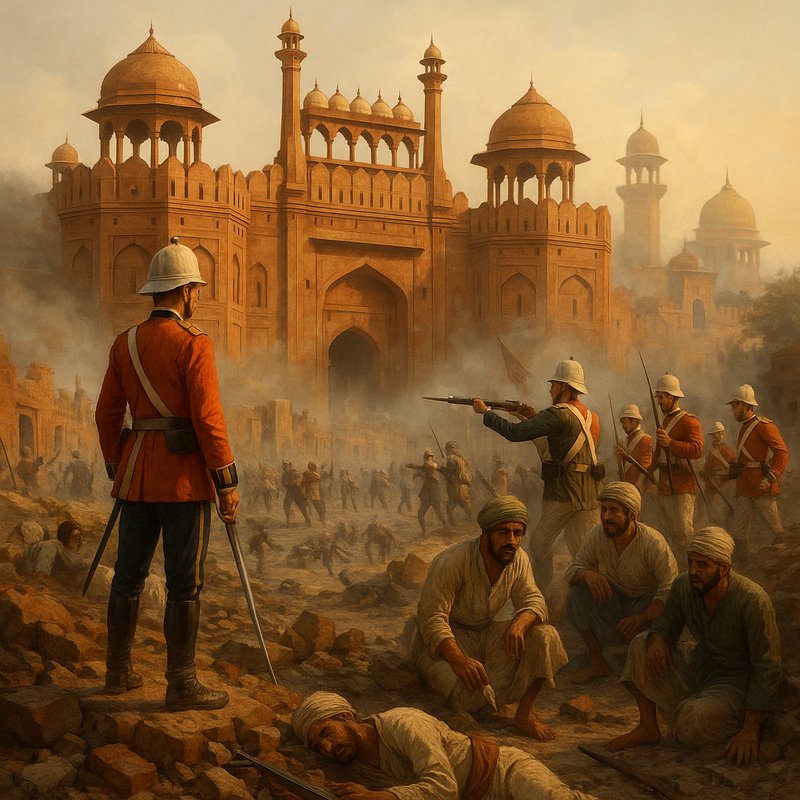
On September 20, 1857, British forces secured final control of Delhi, delivering a crushing blow to the Indian Rebellion. You can trace the uprising's collapse directly to this moment. Rebel sepoys had marched to Delhi to restore Mughal authority under Bahadur Shah, transforming a military mutiny into a political movement. The city's fall ended that dream permanently, shattering coordinated resistance across India. There's much more to uncover about how this pivotal siege unfolded.
Key Takeaways
- The Siege of Delhi concluded on September 20–21, 1857, when British forces established final control after intense street-by-street fighting.
- British forces used artillery to breach key city gates during a decisive assault, overcoming rebel fortifications in September 1857.
- Rebel forces defending Delhi numbered 30,000 to 40,000 trained sepoys, vastly outnumbering the British troops engaged.
- Emperor Bahadur Shah was captured and exiled, marking the definitive end of the Mughal dynasty and authority.
- Delhi's fall shattered coordinated rebel resistance, decisively shifting the rebellion's momentum and hastening its overall collapse.
Delhi in 1857: The City the Rebels Chose as Their Capital
When the Indian Rebellion erupted in 1857, Delhi wasn't just another city the rebels happened to seize—it was a deliberate choice. You have to understand what Delhi represented: it was the seat of Mughal Authority, home to Emperor Bahadur Shah, and a powerful symbol of pre-British India. By making it their Rebel Capital, the insurgents sent a clear message—they weren't simply resisting Company rule, they were attempting to restore an entire political order. The city carried centuries of imperial weight, and that mattered deeply to sepoys and civilians alike. Whoever controlled Delhi controlled the narrative of the rebellion. For the rebels, seizing it wasn't just strategic—it was the act that gave their uprising its most compelling sense of legitimacy and purpose.
How the 1857 Uprising Brought Rebel Forces to Delhi
The spark that brought rebel forces to Delhi didn't ignite there—it ignited in Meerut. In May 1857, sepoys mutinied, killed British officers, and marched straight to Delhi. They understood Delhi's significance immediately—it was the seat of Mughal authority, a city that could legitimize their rebellion and rally support across India.
You can trace rebel strategies back to this single calculation: controlling Delhi meant controlling a symbol. Once they arrived, rebel forces persuaded the aging Mughal emperor Bahadur Shah to lead the uprising, instantly transforming a military mutiny into a political movement. Delhi became their capital, drawing tens of thousands of fighters. By the time British forces organized a response, rebels had fortified a city of enormous symbolic and strategic weight.
Who Fought on Each Side at the Siege of Delhi?
Two very different coalitions clashed at Delhi—British, Company, and loyal Indian troops on one side, and a massive rebel force on the other. The rebels fielded roughly 30,000 to 40,000 trained sepoys and native troops, using Rebel Strategies centered on holding the city's fortifications and exploiting their numerical advantage.
You'll notice the British side faced steep odds early on. A relief column of around 3,000 men arrived in June, followed by roughly 1,000 reinforcements in August. British Tactics relied on coordinated assaults, siege artillery, and disciplined infantry advances despite being significantly outnumbered. Nepalese troops and several loyal Indian rulers also supported the British effort. This coalition, though smaller, maintained enough pressure and organization to eventually overwhelm Delhi's defenders through sustained offensive operations.
The British Siege Lines and Stalemate: June to August 1857
Once you understand the forces involved, the siege's grinding middle phase comes into sharper focus. When roughly 3,000 British troops arrived in June 1857, they weren't strong enough to storm Delhi immediately. Instead, British Strategy centered on holding siege lines on the Ridge north of the city, maintaining pressure while awaiting reinforcements.
Rebel Tactics kept the British pinned down through constant sorties and artillery fire. The rebels held roughly 30,000 to 40,000 troops inside the walls, giving them a significant numerical advantage. Throughout June, July, and much of August, neither side broke the deadlock.
The arrival of about 1,000 additional British troops in August finally shifted the balance. That reinforcement gave British commanders enough strength to plan a decisive assault on the city.
The Final British Assault on Delhi Explained
With reinforcements finally in hand, British commanders launched their long-awaited assault on Delhi in September 1857. Their British tactics relied on breaching walls, coordinated column advances, and aggressive military leadership. Rebel strategies forced brutal urban warfare through Delhi's narrow streets for days.
Here's what defined the final assault:
- British forces breached key city gates using artillery before infantry pushed through
- Rebel forces used nineteenth century defensive positions, slowing every advance
- Street-by-street fighting created devastating civilian experiences inside the city
- British columns cleared Delhi fully by September 20–21, 1857
The colonial impact of this victory proved enormous. Delhi's fall crushed Mughal restoration hopes, accelerated rebellion suppression across northern India, and cemented a historical legacy that still shapes how historians assess 1857.
What Happened on September 20, 1857?
By September 20, 1857, the British assault on Delhi had reached its breaking point. After weeks of grinding siege operations, British and loyalist forces had pushed deep into the city, engaging rebel troops in brutal street-by-street combat. You're looking at a moment where Delhi's significance couldn't be overstated — it wasn't just a military objective, it was the symbolic heart of Mughal authority and the rebellion itself.
Rebel resistance was collapsing under relentless pressure, with an estimated 5,000 casualties on their side. British forces had effectively severed the rebels' ability to hold their positions. By this date, control of the city was shifting decisively. What remained was clearing the final pockets of resistance, a task that would conclude within the following day.
What Happened to Bahadur Shah After Delhi Fell?
As Delhi fell, everything unraveled quickly for Bahadur Shah. His royal fate moved fast once British forces secured the city. Here's what happened:
- Bahadur Shah fled the palace before British troops declared the city captured.
- He surrendered after receiving promises that his life would be spared.
- The British placed him under arrest, effectively ending any exile plans he may have held.
- His capture marked the political death of the Mughal legacy, stripping the dynasty of its last symbolic authority.
You can see how swiftly his position collapsed. He'd served as a rallying figure for rebels, but once Delhi fell, he held no power. The British later tried and exiled him to Rangoon, where he died in 1862.
Casualties and Human Cost of the Siege of Delhi
Bahadur Shah's capture closed one chapter of Delhi's fall, but the human cost behind that victory tells the fuller story. British, Company, and loyalist forces suffered 1,254 killed and 4,493 wounded throughout the siege. The last six days of street fighting alone accounted for 992 killed, 2,795 wounded, and 30 missing — numbers that reflect how effectively rebel strategies turned Delhi's narrow streets into deadly terrain. On the rebel side, casualties exceeded 5,000 dead or wounded by unofficial estimates. But you can't measure the full toll in combatant figures alone. Civilian suffering ran deep, as looting and killings followed the British recapture. The city paid an enormous price, and the violence that swept through Delhi left wounds far beyond what any casualty count captures.
Why Recapturing Delhi Broke the Rebellion's Momentum
The human cost behind Delhi's fall mattered enormously, but so did what that fall meant. Delhi wasn't just a city — it was the foundation of rebel strategy. Losing it shattered four things simultaneously:
- The symbolic seat of Mughal authority vanished overnight
- Bahadur Shah's surrender extinguished hopes of restoring imperial rule
- Coordinated rebel resistance across northern India lost its political center
- British imperial control gained momentum that proved nearly impossible to reverse
You can trace the rebellion's decline directly to this moment. Once Delhi fell, remaining rebel forces fought without a unified cause or capital. British forces then systematically suppressed resistance through late 1857 and into 1858. Delhi's recapture didn't just win a battle — it decided the war's outcome.
The Long Shadow of Delhi's Fall on British India
Delhi's fall didn't just end a siege — it rewrote the entire political structure of British India. You can trace the long term implications directly: the British Crown dissolved the East India Company in 1858 and assumed direct control over India. That shift wasn't symbolic — it was total administrative reorganization triggered largely by this rebellion.
Colonial narratives also hardened after Delhi fell. British authorities used the rebellion to justify tighter control, dismissing Indian political aspirations for decades. You'll find that Delhi's recapture gave Britain a story — one of restored order — that shaped imperial policy well into the 20th century.
The Mughal dynasty effectively ended here. Bahadur Shah was exiled, and with him went any remaining framework for indigenous imperial authority across the subcontinent.