

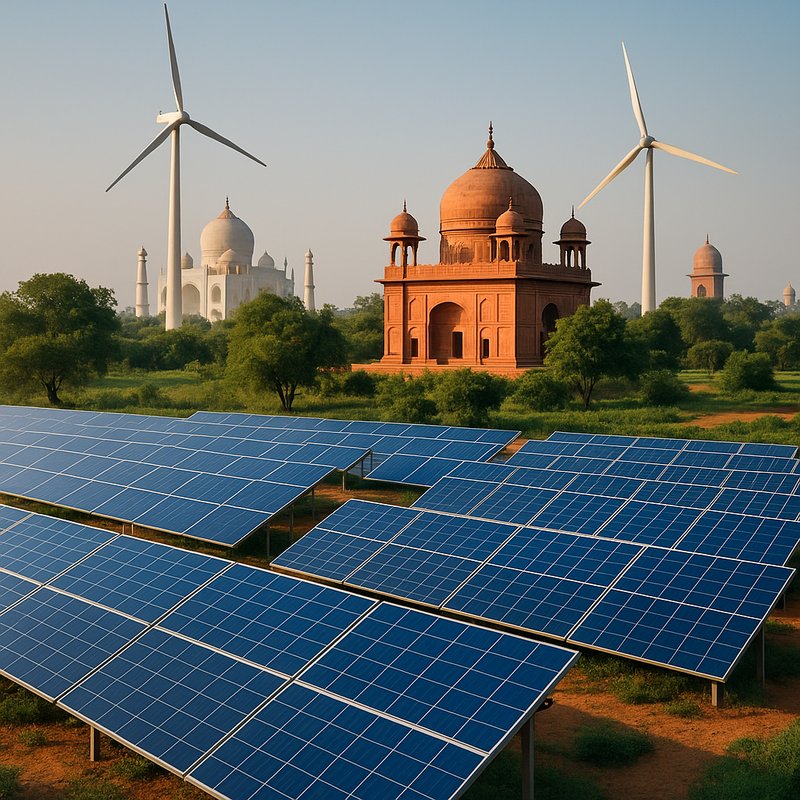
On September 19, 2017, India reaffirmed its massive 175 GW renewable energy target, breaking it down into 100 GW solar, 60 GW wind, 10 GW biomass, and 5 GW small hydro. You can see it's the largest renewable capacity expansion program in the world. Solar parks expanded to 40,000 MW, and eight leading states are driving infrastructure growth. With foreign investments hitting US$11.8 billion, there's much more to uncover about how this plan comes together.
Key Takeaways
- India targets 175 GW renewable energy capacity, including 100 GW solar and 60 GW wind, representing the largest global renewable expansion program.
- Solar Parks and Ultra Mega Solar Power Projects doubled capacity from 20,000 MW to 40,000 MW across 35 approved parks in 21 states.
- Eight leading states drive renewable growth, supported by an Intra-State Transmission System valued at Rs. 10,141 crore.
- Transmission funding splits across 40% Government of India grants, 40% KfW loans, and 20% state equity contributions.
- India attracted US$11.8 billion in foreign direct investment, with 100% FDI permitted in the power sector since 2000.
What India's 175 GW Renewable Energy Target Actually Covers
India's 175 GW renewable energy target, set in 2015, breaks down into four distinct categories: 100 GW solar, 60 GW wind, 10 GW biomass, and 5 GW small hydro. You can see how this distribution reflects deliberate policy implications, prioritizing solar and wind as the dominant renewable technologies while still accounting for biomass and small hydro.
The government also proposed raising the solar renewable purchase obligation to 8% by 2022 under the National Tariff Policy framework. MNRE has described this expansion as the largest renewable capacity expansion programme in the world. Understanding each category helps you grasp how India's diversified approach spreads risk across multiple renewable technologies, ensuring no single energy source carries the entire burden of meeting the nation's clean power ambitions. Similar to Brazil's polluter-pays principle embedded in its 1981 National Environmental Policy, India's renewable framework seeks to ensure that the costs and responsibilities of energy transformation are distributed across industries and stakeholders rather than absorbed by the public alone.
Solar Parks, Rooftop Programs, and the 40,000 MW Push
To meet its solar ambitions, India expanded the Solar Parks and Ultra Mega Solar Power Projects scheme from 20,000 MW to 40,000 MW in March 2017. The solar park expansion already includes 35 approved parks across 21 states, totaling 20,514 MW of aggregate capacity, with a target of over 50 parks nationwide.
On the distributed generation side, MNRE proposed SRISTI to deliver rooftop solar incentives and push installations toward a 40 GW target by 2021-2022. You can see how these two tracks work together—large-scale solar parks anchor utility-level supply while rooftop programs broaden access across homes and businesses. Additional support covers grid-connected solar PV through Viability Gap Funding, including a dedicated 1,000 MW component specifically for India's North-East states.
Which States Are Leading India's Renewable Infrastructure Buildout?
Eight states are leading the charge in renewable infrastructure: Tamil Nadu, Rajasthan, Karnataka, Andhra Pradesh, Maharashtra, Gujarat, Himachal Pradesh, and Madhya Pradesh. These renewable leaders are at the center of India's Intra-State Transmission System, a project costing Rs. 10,141 crore designed to strengthen grid connectivity across energy-rich regions.
Their state contributions aren't just symbolic. The funding structure requires each state to carry 20% equity, while the Government of India covers 40% through grants totaling Rs. 4,056.67 crore, and KfW supplies the remaining 40% via loans. You can see how this shared financial model keeps individual state burdens manageable while accelerating buildout. If India's going to hit its 175 GW renewable target, these eight states will largely determine whether that happens on schedule.
How India's Transmission Network Is Being Wired for Renewable Scale
Building on those eight anchor states, the transmission network connecting them isn't just keeping pace with renewable growth—it's being deliberately engineered to support it. The Intra-State Transmission System covers Tamil Nadu, Rajasthan, Karnataka, Andhra Pradesh, Maharashtra, Gujarat, Himachal Pradesh, and Madhya Pradesh, with transmission upgrades totaling Rs. 10,141 crore. You can see the financing logic clearly: 40% comes from a Government of India grant, 40% from a KfW loan, and 20% from state equity. That structure makes grid integration financially viable without overburdening individual states. India also signed an MoU in April 2017 for BIMSTEC Grid Interconnection, extending connectivity beyond its borders. These moves signal that India isn't building renewable capacity in isolation—it's wiring the infrastructure to move that power reliably.
Who's Funding India's Renewable Energy Expansion?
Funding this scale of expansion requires layered capital, and that's exactly what India's structured. The country allows 100% FDI in the power sector, making investment sources broad and accessible. Since 2000, the sector's pulled in US$11.8 billion in foreign direct inflows, reflecting strong investor confidence.
Financing mechanisms include the National Clean Energy Fund, KfW loans covering 40% of transmission costs, and Government of India grants. Banks extend loans up to Rs. 15 crore for renewable systems, with Rs. 10 lakh available for individual households.
Stakeholder roles span central agencies, state governments, private developers, and international lenders. Policy incentives like Viability Gap Funding and solar purchase obligations keep the pipeline moving. You're looking at a deliberately engineered funding architecture designed to sustain long-term renewable growth.
How 175 GW Could Reshape India's Power Mix by 2030
Capital commitments and financing structures only matter if they produce real change in how a country generates power. India's 175 GW renewable target isn't just an ambitious number—it's a structural shift in how you'd expect the country to generate electricity by 2030. Hitting that mark means 100 GW from solar, 60 GW from wind, and the rest split between biomass and small hydro.
That mix directly supports energy independence by reducing India's reliance on imported fuels. It also fuels economic growth by creating domestic manufacturing demand, jobs, and stable long-term energy pricing. Projections already show cumulative renewable capacity reaching over 100,000 MW by 2020. China's manufacturing consolidation has made India's ambitions more cost-feasible, as economies of scale in solar panel and wind turbine production have significantly reduced equipment procurement costs. If that trajectory holds, India's power mix looks fundamentally different—and far cleaner—well before 2030.