
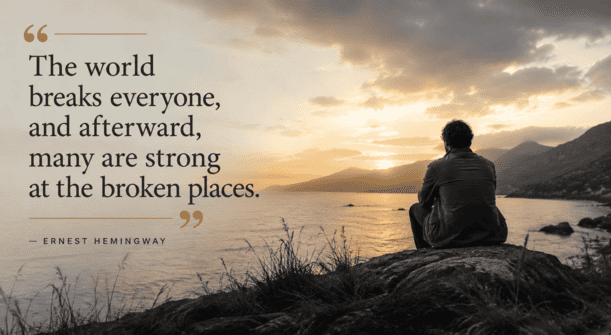
"The world breaks everyone, and afterward, many are strong at the broken places." — Ernest Hemingway, A Farewell to Arms
Ernest Hemingway’s line, “The world breaks everyone, and afterward, many are strong at the broken places,” is one of those literary quotes that stays with people because it feels both harsh and honest. It does not pretend that life is always fair. It does not suggest that suffering automatically makes someone better. Instead, it points to something more complicated: people can be damaged by life and still continue.
The quote is often connected to themes of war, grief, love, loss, and survival. It speaks to the way people carry pain, not as something neatly erased, but as something that changes them.
A Quote About Being Hurt by the World
The first part of the quote is direct: “The world breaks everyone.” That may sound bleak, but it also feels realistic. Hemingway is not saying that every person experiences the same kind of pain. Some people face heartbreak. Others face illness, poverty, violence, failure, loneliness, or loss.
What makes the line powerful is its sense of universality. No one goes through life untouched. Even people who seem strong, successful, or composed often carry private wounds.
This is one reason the quote works so well in an article. It opens the door to discussing how literature gives language to experiences people may struggle to explain.
Strength Does Not Mean Being Unhurt
The second part of the quote is where the meaning deepens: “many are strong at the broken places.” Hemingway does not say that people become untouched or perfect after suffering. He says they may become strong where they were once broken.
That distinction matters.
Strength, in this sense, is not about pretending nothing happened. It is not about hiding pain or acting invincible. It is the kind of strength that comes from surviving something difficult and learning how to live with the memory of it.
A person may become more careful, more compassionate, more self-aware, or more determined after hardship. The wound does not disappear, but the person may develop a new kind of resilience around it.
The Difference Between Healing and Changing
One reason this quote is so memorable is that it does not offer a simple idea of healing. In many stories, recovery is shown as a clean ending: the pain is resolved, the lesson is learned, and life moves forward. Hemingway’s line suggests something less tidy.
Some experiences do not fully leave us. They become part of how we see the world. They may shape our choices, our fears, our relationships, and our understanding of what matters.
This does not mean people are trapped by pain. It means healing can look different from forgetting. Sometimes healing means learning how to carry what happened without letting it control everything.
Why Hemingway’s Words Feel So Honest
Hemingway’s writing is often known for its spare, direct style. He did not usually explain emotions in long, decorative passages. Instead, he often used simple sentences that carried heavy meaning beneath the surface.
This quote reflects that style. The words are plain, but the idea is emotionally layered. There is no easy comfort in it. The line recognizes damage, but it also leaves room for endurance.
That balance is part of why it continues to resonate. It gives readers a way to think about suffering without turning it into a neat inspirational slogan.
The Quote’s Connection to War and Loss
Hemingway’s work was deeply shaped by war, injury, disillusionment, and emotional loss. In A Farewell to Arms, the world is unstable and often cruel. Love exists, but it is not protected from tragedy. Hope exists, but it does not guarantee safety.
Against that background, the quote feels especially powerful. It is not about ordinary inconvenience or temporary sadness. It comes from a literary world where people are forced to confront how fragile life can be.
This makes the line useful for discussing how war literature often portrays strength. Soldiers, nurses, civilians, and survivors may keep going, but they are rarely unchanged by what they have seen.
Why the Quote Still Matters Today
Even outside Hemingway’s original context, the quote remains relevant because people still look for language to describe resilience. Modern readers may connect it to personal grief, mental strain, family struggles, trauma, or major life transitions.
The quote does not promise that pain has a purpose. It does not say every wound creates wisdom. Instead, it suggests that survival itself can create a different kind of strength.
That idea is meaningful because it respects the seriousness of suffering while still acknowledging human endurance.
A Good Article Angle: Resilience Without Romanticizing Pain
A strong article about this quote should be careful not to make suffering sound noble or necessary. Pain does not automatically improve people. Some experiences leave lasting harm, and not everyone becomes stronger in a visible way.
The better angle is to explore resilience honestly. The quote can be used to ask important questions:
What does it mean to be strong after being hurt? Can people heal without returning to who they were before? How does literature help readers understand pain that is difficult to name?
These questions make the quote more than a motivational line. They turn it into a thoughtful discussion about survival, memory, and the human capacity to keep living after loss.
Conclusion
“The world breaks everyone, and afterward, many are strong at the broken places” remains powerful because it does not simplify life. It recognizes that people are wounded by the world in different ways. It also recognizes that those wounds do not always mean defeat.
Hemingway’s line suggests that strength can come from the very places where life has left its mark. Not because suffering is good, but because people can endure, adapt, and continue.
That is what makes the quote worth writing about. It speaks to the difficult truth that being broken and being strong are not always opposites. Sometimes, they exist in the same person.