
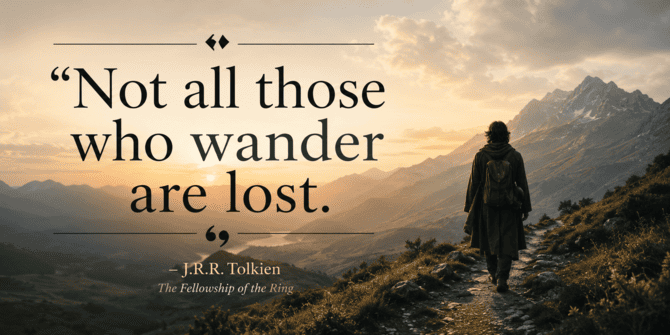
Some quotes become popular because they are short and easy to remember. Others last because they say something people continue to feel across generations. J.R.R. Tolkien’s famous line, “Not all those who wander are lost,” does both.
At first, it sounds like a simple statement about travel. But the quote has a deeper meaning. It reminds us that moving through life without a clear or ordinary path does not always mean a person is confused. Sometimes, wandering is part of growth, discovery, and purpose.
The Meaning Behind the Quote
The quote suggests that not every person who takes an unusual path is aimless. Some people learn by exploring. Some find meaning through experience rather than strict planning. Others may seem uncertain from the outside, but they are actually following a quiet purpose of their own.
In daily life, people often expect success to look neat and direct. Go to school, choose a career, settle down, follow a plan. But real life is rarely that simple. People change jobs, move cities, restart their goals, or take time to understand who they are.
Tolkien’s quote gives dignity to that kind of journey. It says that wandering is not the same as being lost.
Where the Quote Comes From
The line appears in The Fellowship of the Ring, the first volume of Tolkien’s The Lord of the Rings. It is part of a poem connected to Aragorn, a character who is far more important than he first appears.
Aragorn is introduced as a wandering ranger, someone who lives outside the usual centers of power and comfort. To many, he may look like a mysterious traveler with no fixed place. But his wandering hides strength, wisdom, and a larger destiny.
That context gives the quote extra weight. It is not just about walking from place to place. It is about hidden purpose. A person may look ordinary, unsettled, or hard to understand, while still carrying great value.
Why People Connect With It
Many people connect with this quote because it challenges the idea that everyone must follow the same timeline. Some people discover their path early. Others need more time. Some people try many things before finding what feels right.
The quote is especially meaningful for students, travelers, artists, career changers, and anyone going through a season of uncertainty. It offers comfort without pretending that life is always easy.
It also speaks to people who feel judged for not having everything figured out. Tolkien’s line gently reminds us that uncertainty can be part of becoming more aware, more capable, and more honest with ourselves.
Wandering as a Form of Learning
Wandering can teach lessons that a fixed plan cannot. When people explore new places, ideas, relationships, or careers, they often learn what matters to them. They also learn what does not.
This does not mean that planning is bad. Plans are useful. Goals can give direction. But too much pressure to have a perfect plan can make people afraid to try, change, or grow.
Wandering allows room for curiosity. It creates space for mistakes, surprises, and new understanding. In that sense, wandering can be a practical way of learning.
The Difference Between Wandering and Being Lost
Being lost often means having no sense of direction, no awareness of where you are, or no idea how to move forward. Wandering is different. A person who wanders may not know every step ahead, but they are still paying attention.
They may be searching. They may be observing. They may be testing different roads before choosing one.
The quote does not romanticize confusion. Instead, it makes an important distinction: an unclear path is not always a meaningless one.
A Quote for Modern Life
In today’s world, people often compare their lives to others. Social media can make it seem like everyone else is moving faster, achieving more, or living with total certainty. That can make personal uncertainty feel like failure.
Tolkien’s quote pushes back against that pressure. It reminds us that life does not have to follow one approved pattern. A meaningful life can include detours, pauses, and unexpected turns.
Sometimes, the person who seems to be wandering is simply taking a path that others do not recognize yet.
Final Thoughts
“Not all those who wander are lost” remains popular because it gives people permission to see their own journey differently. It does not shame uncertainty. It does not demand a perfect plan. Instead, it suggests that movement, curiosity, and patience can all be part of finding one’s way.
Tolkien’s words continue to matter because they speak to a simple truth: a person’s path may look unclear from the outside, but that does not mean it lacks meaning.
Sometimes, wandering is how we discover where we truly belong.