
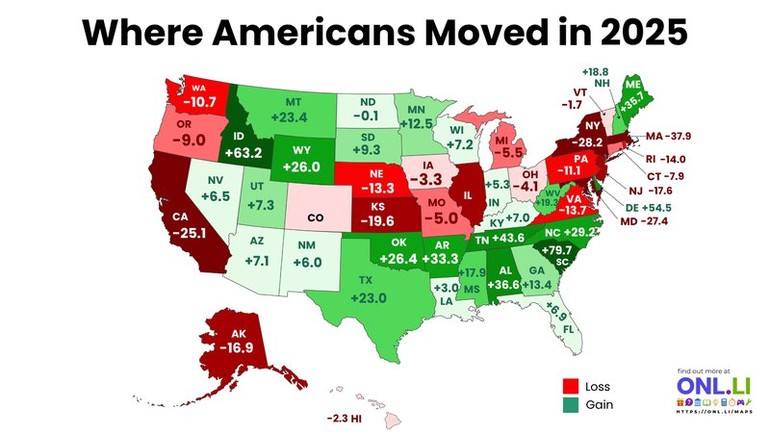
Where Americans choose to move can reveal changing economic opportunities, housing affordability, lifestyle preferences, and employment trends. This map highlights each state's estimated net migration in 2025, showing which parts of the country gained new residents and which experienced more people leaving than arriving.
While migration patterns change from year to year, the overall picture reflects broader demographic shifts. Many fast-growing states in the South and Mountain West continue attracting newcomers, while several states along the West Coast and Northeast recorded net population losses.
The South Continues to Attract New Residents
Several Southern states posted some of the strongest migration gains in 2025. North Carolina led the nation with a gain of nearly 80, while Tennessee, Alabama, Arkansas, and Texas also welcomed substantial numbers of new residents.
Many newcomers are drawn by relatively affordable housing, expanding job markets, lower taxes in some states, and a generally lower cost of living compared with many coastal metropolitan areas.
Mountain West States Remain Popular
The Mountain West continued to experience strong population growth through domestic migration. Idaho recorded one of the largest gains on the map, followed by Wyoming and Montana, reinforcing the region's reputation as one of America's fastest-growing areas.
Outdoor recreation, growing technology sectors, and the appeal of smaller cities and open spaces have encouraged many Americans to relocate to these states over the past several years.
Coastal States Saw Larger Outflows
Several traditionally populous states experienced notable migration losses during 2025. California, New York, Massachusetts, New Jersey, Maryland, and Washington all posted negative figures, continuing trends seen in recent years.
High housing costs, increased living expenses, and the growing ability to work remotely have encouraged some residents to relocate to more affordable parts of the country while maintaining similar careers.
Not Every Neighbor Followed the Same Pattern
Migration trends often varied dramatically between neighboring states. Delaware experienced one of the largest gains in the Northeast, while nearby Maryland and New Jersey recorded significant losses.
Likewise, Nevada, Arizona, and Utah continued attracting new residents even as neighboring California experienced one of the nation's largest net outflows.
Migration Reflects Changing Priorities
Population movement is influenced by a wide range of factors, including employment opportunities, housing affordability, taxes, climate, retirement decisions, and quality of life. Because these factors constantly evolve, migration patterns can shift from one year to the next.
Maps like this offer a snapshot of where Americans chose to relocate during a single year, illustrating how demographic trends continue to reshape communities across the United States.