
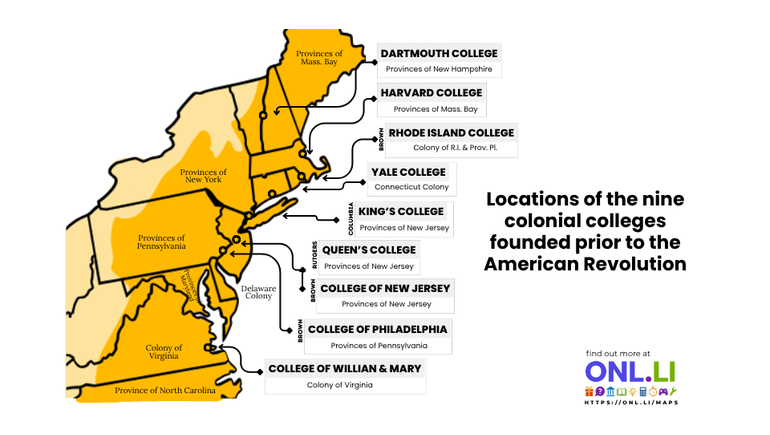
Before the United States became an independent nation, higher education in the colonies was already taking shape. The map shows the locations of the nine colonial colleges founded before the American Revolution. These schools were established between the 1600s and 1700s, when education was closely tied to religion, public leadership, law, medicine, and the training of clergy.
Today, many of these institutions are among the most famous universities in the United States. But in their early years, they were small colonial schools serving a very different society.
What Were the Colonial Colleges?
The “colonial colleges” refers to nine institutions of higher learning founded in the British American colonies before the American Revolution. They were created before the United States existed as a country.
These colleges were not large universities in the modern sense. Most had small student bodies, strict rules, classical curricula, and strong religious connections. Students often studied subjects such as Latin, Greek, logic, philosophy, theology, and mathematics.
Their main purpose was to prepare educated men for leadership roles in church, government, law, and civic life.
The Nine Colleges Founded Before the Revolution
The map highlights these nine colonial colleges:
Harvard College
Harvard College was founded in 1636 in the Massachusetts Bay Colony. It is the oldest institution of higher education in what became the United States.
Harvard was originally created to train ministers for the Puritan colony. Over time, it grew into one of the most influential universities in the world.
College of William & Mary
The College of William & Mary was founded in 1693 in the Colony of Virginia. It became an important educational center in the southern colonies.
The school educated several major figures in early American history, including future presidents, lawmakers, and judges. Its location in Williamsburg connected it closely with colonial Virginia’s political life.
Yale College
Yale College was founded in 1701 in Connecticut Colony. Like Harvard, Yale had strong religious roots and was created partly to train clergy.
It later became one of New England’s most important centers of education. Its early curriculum focused heavily on classical studies and Christian theology.
College of New Jersey
The College of New Jersey was founded in 1746 in the Province of New Jersey. It is now known as Princeton University.
This college became especially important during the Revolutionary era. Its location in New Jersey placed it near major political and military events of the period.
King’s College
King’s College was founded in 1754 in the Province of New York. It is now Columbia University.
Because it was founded under royal charter, the name “King’s College” reflected loyalty to the British Crown. After the American Revolution, the school was renamed Columbia College, a name that better fit the new republic.
College of Philadelphia
The College of Philadelphia was founded in 1755 in the Province of Pennsylvania. It later became part of the University of Pennsylvania.
Unlike some earlier colonial colleges, it had a more practical educational vision. Benjamin Franklin was closely involved in its founding, and he supported a broader curriculum that included modern subjects useful for public and commercial life.
Rhode Island College
Rhode Island College was founded in 1764 in the Colony of Rhode Island and Providence Plantations. It is now Brown University.
The school was notable for its Baptist roots, though Rhode Island itself was known for a wider degree of religious freedom than many other colonies.
Queen’s College
Queen’s College was founded in 1766 in the Province of New Jersey. It is now Rutgers University.
It was established by ministers of the Dutch Reformed Church. Like many colonial colleges, it began with a religious mission but later developed into a broader public university.
Dartmouth College
Dartmouth College was founded in 1769 in the Province of New Hampshire.
Its original mission included educating Native American students and training ministers, although its history in that area is complex. Located farther north than the other colonial colleges, Dartmouth reflected the spread of colonial settlement and education into New England’s interior.
Why Most Were in the Northeast
One of the most noticeable things about the map is the concentration of colleges in New England and the Middle Colonies. Massachusetts, Connecticut, Rhode Island, New York, New Jersey, Pennsylvania, and New Hampshire all had colonial colleges before the Revolution.
Several factors help explain this pattern. Northern colonies had towns with strong church networks, printing culture, and local support for formal education. Many communities valued literacy because reading scripture, legal documents, and civic records was considered important.
The southern colonies had fewer colleges, partly because settlement patterns were more spread out. Wealthy families often sent sons to Europe or hired private tutors instead of relying on local colleges.
Religion and Education Were Closely Connected
Religion played a major role in the founding of these schools. Harvard, Yale, Princeton, Brown, Rutgers, and Dartmouth all had strong religious origins or denominational ties.
This does not mean they were all the same. Different colonies had different religious cultures. Puritans, Anglicans, Presbyterians, Baptists, and Dutch Reformed leaders all influenced education in different places.
In colonial America, higher education was often seen as a way to create morally disciplined leaders. A college education was not only about knowledge. It was also about shaping public character.
Education Was Limited to a Small Group
It is important to remember that colonial colleges served only a tiny portion of the population. Most students were white men from families with the money, connections, or social position to pursue advanced education.
Women were generally excluded from these institutions. Enslaved people, free Black people, Native Americans, and poor colonists faced severe barriers to formal higher education.
So while these colleges became important in American history, they also reflected the inequalities of colonial society.
How These Colleges Influenced the American Revolution
By the mid-1700s, these schools had helped educate many colonial leaders, ministers, lawyers, writers, and political thinkers. College campuses became places where students and professors discussed philosophy, government, rights, religion, and empire.
Ideas from the Enlightenment also shaped the thinking of educated colonists. Concepts such as natural rights, consent of the governed, and civic responsibility became part of the intellectual world that influenced the Revolution.
Not every colonial college supported independence in the same way. Some had loyalist ties, while others became associated with patriot leaders. Still, together, they helped create an educated class that played a major role in the founding era.
What These Schools Became Today
The nine colonial colleges are now known by these modern names:
Harvard University, William & Mary, Yale University, Princeton University, Columbia University, University of Pennsylvania, Brown University, Rutgers University, and Dartmouth College.
Several are now part of the Ivy League, while others are major public or historic institutions. Their missions have changed greatly since the colonial period. They now offer broad fields of study, serve much larger student populations, and have global reputations.
Why the Map Matters
The map gives a clear picture of where early American higher education first took root. It shows that colonial colleges were not evenly spread across the colonies. They clustered mainly in the Northeast, with Virginia as the major southern exception.
It also reminds us that education was deeply connected to religion, politics, geography, and social class. These colleges helped train leaders before the United States existed, and their influence continued long after independence.
Final Thoughts
The nine colonial colleges were small by modern standards, but their historical importance is large. They shaped early American intellectual life, trained influential leaders, and helped establish the idea that higher education would play a central role in public life.
Looking at their locations helps us understand more than where schools were built. It shows how colonial society valued education, how power was concentrated, and how ideas moved through the colonies before the American Revolution.