
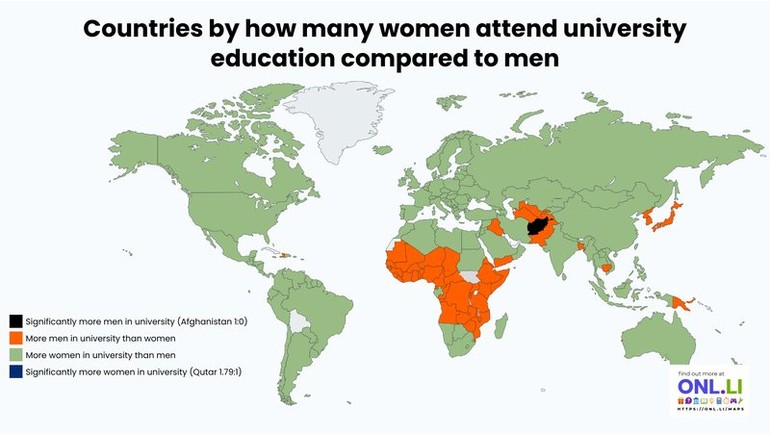
Higher education has changed dramatically over the past several decades, and in many parts of the world women now enroll in universities at higher rates than men. This map highlights the balance between male and female participation in tertiary education, revealing that female students make up the majority of university enrollments across much of Europe, the Americas, and large parts of Asia.
While the global trend points toward growing female participation in higher education, the picture is far from uniform. Several countries, particularly in parts of Africa and Southwest Asia, still have more men attending universities than women, reflecting differences in educational access, economic conditions, cultural expectations, and government policies.
Women Now Outnumber Men in Many Universities
Across much of the developed world, women have become the majority of university students. Countries such as Canada, the United States, the United Kingdom, France, Australia, and many others consistently report higher female enrollment in undergraduate and graduate programs.
Researchers attribute this trend to increased educational opportunities, changing workforce demands, improved access to higher education, and greater participation of women across nearly every academic discipline.
Regional Differences Remain Significant
Although female enrollment has expanded globally, considerable regional differences remain. In several countries across Sub-Saharan Africa and parts of the Middle East and South Asia, men continue to represent a larger share of university students.
These differences often reflect a combination of economic barriers, rural access to education, cultural expectations, conflict, and unequal educational opportunities that affect school completion before students even reach university age.
Afghanistan Represents an Extreme Case
The map identifies Afghanistan as an exceptional case because women currently have virtually no access to university education following restrictions imposed in recent years. As a result, higher education has become overwhelmingly male.
International organizations continue to express concern about the long-term consequences of limiting educational opportunities for women, noting the effects on economic development, healthcare, scientific research, and future workforce participation.
Education Shapes Economic Development
University enrollment is more than an academic statistic. Countries with broader access to higher education generally benefit from a more skilled workforce, greater innovation, and stronger long-term economic growth.
As more women earn university degrees, they increasingly contribute to fields such as medicine, engineering, business, education, science, law, and technology, helping reshape labor markets around the world.
A Global Trend Still in Progress
Although the overall direction is clear, gender balance in higher education continues to evolve. Some countries are working to improve educational access for girls and women, while others are beginning to examine why male university enrollment has declined relative to female enrollment.
Maps like this illustrate how access to education varies across the world. They also remind us that university participation reflects broader social, economic, and political conditions that differ greatly from one country to another.