
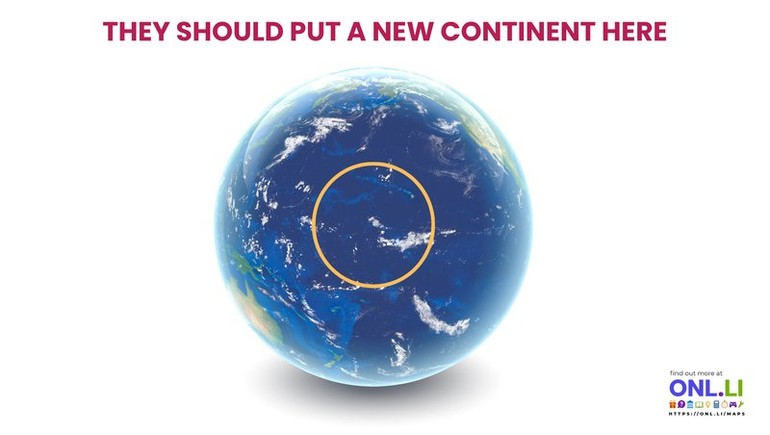
More than 70% of Earth's surface is covered by water, and the central Pacific Ocean contains one of the largest uninterrupted stretches of open ocean anywhere on the planet. Looking at a globe, it's easy to joke that there seems to be plenty of room for "another continent" in the middle of the Pacific.
The reality, however, is very different beneath the surface. The area highlighted on this map is dominated by deep ocean basins, underwater volcanic mountains, and scattered island chains rather than a hidden landmass waiting to emerge. Even though it appears empty on a map, this vast region contains thousands of islands, diverse marine ecosystems, and some of the deepest waters on Earth.
The Largest Ocean on Earth
The Pacific Ocean covers more than 165 million square kilometers (64 million square miles), making it larger than all of Earth's continents combined. The enormous distances between island groups create the impression of a vast empty space, but countless volcanic seamounts, coral reefs, and atolls lie beneath the waves.
Many of these islands were formed by volcanic hotspots, while others developed as coral reefs grew around sinking volcanoes over millions of years.
A Region Filled With Island Nations
Although no continent occupies the center of the Pacific, the region is home to numerous island countries and territories, including Kiribati, Tuvalu, the Marshall Islands, Samoa, Tonga, and parts of French Polynesia.
These islands have rich cultures, unique ecosystems, and long maritime traditions. For thousands of years, Pacific Islanders navigated immense ocean distances using stars, currents, wave patterns, and winds long before modern navigation existed.
Why a New Continent Cannot Simply Be Added
Continents are not simply large pieces of land that can be placed wherever space exists on a map. They are massive sections of Earth's continental crust that have formed over hundreds of millions of years through plate tectonics, volcanic activity, and geological processes.
The highlighted portion of the Pacific is primarily underlain by dense oceanic crust that lies thousands of meters below sea level. Creating a continent there would require geological processes far beyond anything humans could accomplish.
One of Earth's Most Remote Places
Part of this general region contains the South Pacific Gyre, home to Point Nemo—the oceanic pole of inaccessibility. This location is farther from any land than anywhere else on Earth, making it one of the planet's most isolated places.
Because of its remoteness, Point Nemo is sometimes used as the designated reentry area for decommissioned spacecraft, allowing them to fall into a sparsely traveled section of the ocean.
A Funny Idea That Highlights Earth's Scale
The title of this map is clearly meant as a joke, but it also illustrates just how immense the Pacific Ocean truly is. What appears to be unused space on a world map is actually an incredibly dynamic environment shaped by tectonic plates, deep trenches, volcanoes, ocean currents, and thousands of islands spread across millions of square kilometers.
Maps like this remind us that empty-looking places often contain remarkable geography. The Pacific may not have room for a new continent, but it already holds one of the most fascinating and least explored parts of our planet.