
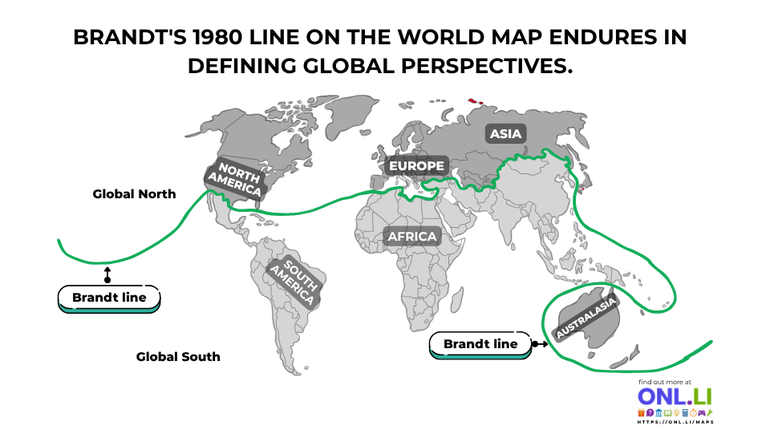
The map highlights one of the most influential ways people have visualized global inequality: the Brandt Line. First popularized through the 1980 Brandt Report, led by former West German Chancellor Willy Brandt, the line divided the world into a wealthier “Global North” and a less wealthy “Global South.”
It was never a perfect border, but it became a powerful shorthand for talking about development, wealth, trade, and global power.
What Is the Brandt Line?
The Brandt Line is an imaginary line drawn around the world to separate countries with generally higher levels of wealth and industrial development from those with lower levels of income and development. In its classic form, the line runs roughly around 30 degrees north latitude, but it bends southward to include countries such as Australia and New Zealand in the Global North.
Above the line were countries often associated with industrialized economies, higher incomes, stronger infrastructure, and greater influence in global institutions. Below the line were many countries in Africa, Latin America, South Asia, Southeast Asia, and parts of the Middle East that had lower average incomes and faced deeper development challenges.
Why the Line Mattered
The Brandt Line gave people a simple visual way to understand a complicated global issue. It showed that poverty and wealth were not randomly spread across the planet. Many countries in the Global South shared histories of colonialism, resource extraction, unequal trade relationships, and limited access to capital.
The Brandt Report argued that the gap between wealthy and poorer countries was not just a local problem for developing nations. It framed global inequality as a shared international challenge that affected trade, security, migration, food systems, debt, and political stability.
Global North and Global South
The terms “Global North” and “Global South” are still widely used today, but they are more political and economic than strictly geographic. Australia is in the Southern Hemisphere but is usually grouped with the Global North. Meanwhile, countries such as China, India, and Mexico are north of the equator but are often discussed as part of the Global South.
That is why the map’s curved green line is important. It shows that the Brandt Line was never just about latitude. It was about economic power.
Why the Brandt Line Needs an Update
The world has changed greatly since 1980. Some countries once clearly associated with the Global South have become major economic powers. China is now one of the world’s largest economies. India has become a major technology, manufacturing, and services hub. Countries such as Brazil, Indonesia, Mexico, Turkey, South Korea, and South Africa play major roles in regional and global affairs.
At the same time, the divide has not disappeared. The World Bank still classifies economies by income level, and major gaps remain between high-income countries and low-income or lower-middle-income countries.
Global finance also remains uneven. UNCTAD’s 2025 Trade and Development Report notes that developing countries are especially exposed to pressures from trade, debt, credit access, currency markets, and financial instability.
A More Complicated World
Today’s world is harder to divide into two neat categories. Some Global South countries have advanced cities, major industries, space programs, technology sectors, and expanding middle classes. Some Global North countries also contain deep poverty, regional decline, housing crises, and communities left behind by globalization.
This means the old line can still be useful as a starting point, but it can also hide important details. A country may be powerful in one area and vulnerable in another. It may have a strong export economy but weak public services. It may have wealthy cities and poor rural regions. It may be politically influential but still face major development challenges.
Why the Idea Still Endures
The Brandt Line remains important because it captures a real historical pattern. Much of the world’s wealth and institutional power is still concentrated in North America, Europe, Japan, Australia, and a few other high-income economies. Many countries in Africa, Latin America, and parts of Asia still face heavier debt burdens, lower average incomes, weaker infrastructure, and less influence over global financial rules.
The line endures because it simplifies a real imbalance. But it needs to be understood as a framework, not a fixed truth.
The Big Takeaway
Brandt’s 1980 line helped shape how the world talks about inequality, development, and power. It gave us the language of the Global North and Global South, and that language still matters.
But the modern world no longer fits cleanly into the old map. Economic growth, new trade networks, emerging powers, climate vulnerability, technology, and debt have made the picture more complex. The Brandt Line still helps explain where many global inequalities came from, but understanding today’s world requires looking beyond the line itself.