

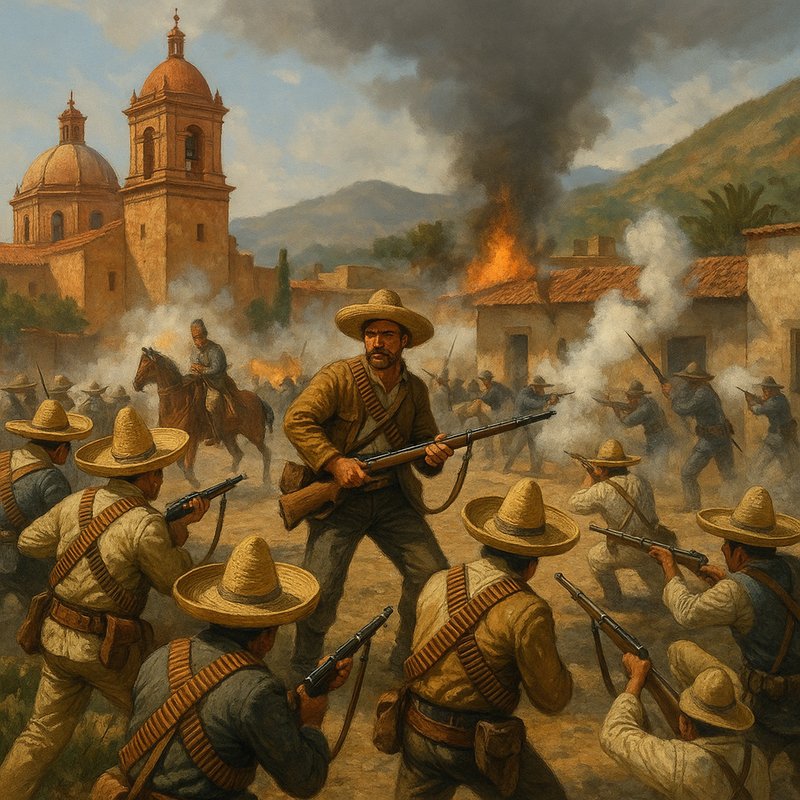
By September 23, 1913, you're looking at a Mexico that's fractured across thirteen states simultaneously. Huerta's coup didn't restore order — it multiplied the conflict. Villa had already assembled roughly 8,000 men in Chihuahua, federal positions were collapsing, and Zapata and Carranza were each fighting for entirely different goals. Huerta's grip was loosening faster than most observers expected. Keep going, and you'll see exactly how it all unraveled.
Key Takeaways
- By September 23, 1913, thirteen states were in open revolt, confirming revolutionary conflicts had spread far beyond any single region.
- Huerta's military position was unsustainable by this date, with federal forces collapsing under Villa's northern offensive in Chihuahua.
- Villa had assembled roughly 8,000 men by late September, launching a rapid offensive that exposed systemic federal weakness nationwide.
- Revolts remained fragmented, with no unified command connecting Zapata, Villa, and Carranza, each pursuing distinct regional agendas.
- September 23, 1913 marked a turning point from regional insurgency to nationwide civil war, accelerating civilian displacement and regime collapse.
Why Huerta's 1913 Coup Turned One Revolt Into Many
Victoriano Huerta's February 1913 coup didn't end Mexico's revolution—it multiplied it. When Huerta seized power after murdering Francisco I. Madero and José María Pino Suárez, he didn't inherit a stable country. He inherited a powder keg.
You can trace the explosion across multiple fronts. Venustiano Carranza challenged Huerta through the Plan de Guadalupe, demanding constitutional restoration. Emiliano Zapata kept fighting in Morelos, driven by deep rural grievances over land. Pancho Villa launched an independent northern campaign from Chihuahua. These weren't coordinated efforts—they were separate revolts fueled by distinct agendas.
Huerta also struggled to secure foreign recognition, which undermined his political legitimacy internationally. What began as one revolutionary conflict had fractured into a nationwide civil war with no unified command and no clear end. This pattern of rapid centralisation of power following a coup, as later seen in Afghanistan in 1978, consistently provoked opposition and accelerated instability rather than restoring order.
Which 13 States Were Already Fighting by September 1913?
By September 1913, thirteen states had already broken into open revolt against Huerta's government: Chiapas, Colima, Durango, Guerrero, Michoacán, Nayarit, Nuevo León, San Luis Potosí, Sinaloa, Tabasco, Tamaulipas, Veracruz, and Yucatán.
These weren't coordinated strikes — they were separate rural uprisings driven by local leadership responding to regional grievances. You'd find no unified command connecting them, no shared strategy guiding their actions.
Resource scarcity made each revolt harder to sustain. Fighters lacked weapons, supplies, and consistent manpower.
Communication breakdown kept these movements isolated, preventing leaders from coordinating attacks or reinforcing one another's positions.
What this map of rebellion revealed, though, was undeniable: Huerta couldn't control the country. Thirteen states fighting simultaneously exposed the fragility of his regime before the year had even ended.
Why These Rebellions Never Coordinated
Thirteen states were fighting Huerta simultaneously, yet none of them fought together. You'd expect that much resistance to organize into something powerful, but it didn't. Each uprising relied on local leadership—regional commanders who answered to their own communities, their own grievances, and their own political goals. Nobody was building a shared strategy.
Communication breakdown made coordination nearly impossible. Without reliable telegraph lines or unified command structures, rebel groups in Chiapas had no practical way to align their movements with those in Tamaulipas or Yucatán. Distance and distrust widened the gap further.
The deeper problem was political. Villa, Zapata, and Carranza each pulled in different directions. When your leaders can't agree on what the revolution means, the fighters beneath them can't march together either. This fragmentation echoes later conflicts where extremist groups like IS-K exploited the absence of unified opposition to continue targeting vulnerable communities with little coordinated resistance.
Villa, Zapata, and Carranza: Three Leaders, Three Agendas
Three men led the revolution against Huerta, but they didn't want the same thing. Emiliano Zapata fought for land reform in the south, demanding that peasants reclaim soil taken by wealthy landowners. His movement stayed rooted in Morelos, built on tight regional alliances with farming communities who backed him fiercely.
Pancho Villa operated from Chihuahua with a massive armed force, prioritizing military dominance over political ideology. He built regional alliances across the north through speed, loyalty, and battlefield results rather than formal doctrine.
Venustiano Carranza pushed a different goal entirely—restoring constitutional government. He wanted legal order, not social revolution. You can see why coordination among these three proved nearly impossible. Their motivations didn't overlap enough to build a unified command, making the anti-Huerta effort fragmented by design.
How Villa, Zapata, and Carranza Each Fought the Mexican Revolution Differently
Each leader's fighting style mirrored his political goals. Zapata relied on guerrilla tactics in Morelos, striking federal forces fast and retreating into familiar terrain. His fight centered on land reform, returning stolen hacienda land directly to peasant communities. You'd see his men disappear into the hills after each raid, ungovernable and deeply local.
Villa fought differently. He built a conventional army, launched frontal assaults, and seized northern cities to control supply lines and communications. Carranza focused less on battlefield brilliance and more on political propaganda and foreign relations, working to legitimize his Constitutionalist movement internationally and win U.S. recognition. Where Villa used firepower and Zapata used the land, Carranza used diplomacy and political positioning to outlast his rivals.
Villa's Northern Offensive: 8,000 Men and a Week of Federal Defeats
By late September 1913, Villa had assembled roughly 8,000 men and set them loose against federal positions across Chihuahua. You'd see his forces move fast, using cavalry tactics to strike before federal commanders could regroup or call for reinforcements. Villa didn't just rely on battlefield speed—he'd built a reliable civilian logistics network that kept his troops supplied with ammunition, food, and fresh horses across difficult terrain.
Federal soldiers crumbled under that pressure in less than a week. Villa's combination of frontal assaults and rapid flanking maneuvers left defenders with little time to organize resistance. Each captured position gave Villa control over communication routes and pushed his forces closer to central Mexico, accelerating the broader collapse of Huerta's military credibility across the north.
How Federal Defeats in Chihuahua Exposed Huerta's Military Weakness
The rapid collapse of federal positions across Chihuahua didn't just hand Villa strategic territory—it tore open a far deeper problem for Huerta's government. When you examine how quickly federal troops folded against roughly 8,000 of Villa's men, the pattern isn't simply battlefield failure. It's systemic.
Logistical failures left federal units undersupplied and poorly positioned, making coordinated defense nearly impossible. Troop morale deteriorated sharply as soldiers recognized they were fighting a losing campaign with inadequate support.
Huerta couldn't project reliable military strength across a country already fracturing into multiple rebellions. Each federal defeat reinforced the perception that his regime was hollow at its core. Chihuahua didn't just weaken Huerta militarily—it signaled to every rival faction that his government was genuinely vulnerable.
What September 23, 1913 Actually Meant for the War
September 23, 1913 didn't mark a single decisive battle—it marked the moment the war's character fundamentally shifted. You're no longer looking at a regional insurgency. You're watching a nationwide civil war with competing revolutionary factions, each pursuing incompatible goals.
Villa's northern offensive demonstrated that Huerta couldn't hold territory or suppress dissent simultaneously. Thirteen states had already staged separate revolts, accelerating civilian displacement on a massive scale. Ordinary Mexicans fled fighting zones with no coordinated relief waiting for them.
Internationally, the instability invited scrutiny. Foreign intervention became increasingly likely as the U.S. watched Huerta's grip loosen. September 23rd crystallized what was already true—Huerta's regime was militarily unsustainable, politically isolated, and heading toward collapse faster than most observers had anticipated.