

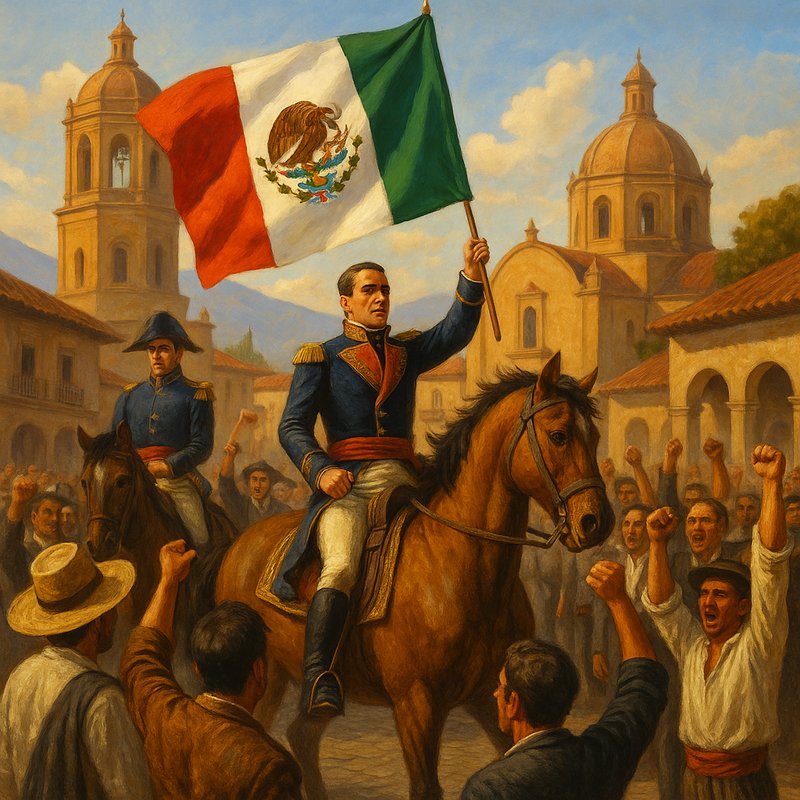
If you're pinning Mexico's formal independence to September 24, 1821, you're recognizing the date Spain officially acknowledged Mexican sovereignty through the Treaty of Córdoba. The road there wasn't short — it took 11 years of conflict, starting with Hidalgo's Grito de Dolores in 1810. Iturbide and Guerrero helped seal the deal, but the struggle was bigger than any document. Keep going to uncover the full story behind Mexico's hard-won freedom.
Key Takeaways
- Mexico formally gained independence from Spain on September 24, 1821, marking the legal conclusion of an 11-year war beginning in 1810.
- The Treaty of Córdoba, signed August 24, 1821, between Iturbide and Viceroy O'Donojú, established the formal negotiated terms of independence.
- Agustín de Iturbide's Plan of Iguala unified opposing factions by guaranteeing Catholicism, constitutional monarchy, and equal rights.
- The Army of the Three Guarantees entered Mexico City on September 27, 1821, followed by the Act of Independence on September 28.
- While September 24, 1821 marks formal independence, Mexican celebrations honor September 16, 1810, the start of the liberation struggle.
How 11 Years of Conflict Led to Mexican Independence
On September 16, 1810, Father Miguel Hidalgo y Costilla delivered El Grito de Dolores, igniting a war that'd consume Mexico for 11 years before Spain finally relinquished its 300-year colonial grip on New Spain.
You can trace the conflict's momentum through relentless rural uprisings that destabilized Spanish authority across the countryside, forcing colonial administrators into a prolonged, costly defensive posture.
Economic disruption compounded the pressure, draining resources from both sides and weakening Spain's ability to maintain control.
By 1821, Agustín de Iturbide and Vicente Guerrero united opposing factions under the Plan of Iguala, consolidating military and political support.
That coalition proved decisive, pushing Spain toward formal negotiations and ultimately the Treaty of Córdoba, signed August 24, 1821.
Similar to how Mexico's independence marked a shift in sovereignty, Hawaii's later transition from an independent kingdom to U.S. territory in 1898 reflected how loss of native sovereignty could result from prolonged foreign economic and political involvement.
Hidalgo, Iturbide, and Guerrero: The Men Behind Independence
Three men shaped Mexican independence more than any others, each contributing at a distinct and critical phase of the 11-year struggle.
Father Miguel Hidalgo launched the movement through religious leadership and social mobilization, rallying thousands with his 1810 Grito of Dolores. Agustín de Iturbide and Vicente Guerrero then united opposing factions to finalize independence.
Each leader brought something irreplaceable:
- Hidalgo ignited mass rebellion by leveraging his clerical authority and community trust.
- Iturbide authored the Plan of Iguala in February 1821, establishing a constitutional monarchy framework.
- Guerrero collaborated with Iturbide to guarantee equal rights for criollos and peninsulares.
Without their combined efforts across different phases, Mexico's path to sovereignty would've collapsed long before the 1821 proclamation.
The Plan of Iguala: What It Promised the New Nation
The Plan of Iguala laid out three core promises that would define Mexico's new national identity. Authored by Agustín de Iturbide in February 1821, it established a clear vision for the nation you'd be inheriting from Spanish colonial rule.
First, it enforced a religious monopoly, designating Roman Catholicism as the sole official religion. Second, it introduced a monarchical structure, positioning Mexico as a constitutional monarchy rather than a republic. Third, it guaranteed racial equality, granting Peninsulares and Creoles identical political and social rights — a promise Vicente Guerrero helped shape.
The plan also carried deep political symbolism, uniting formerly opposing factions under shared national principles. These three guarantees didn't just outline governance — they gave Mexico's independence movement a unified, actionable framework everyone could rally behind. Just decades later, the young nation would face significant territorial losses when the Treaty of Guadalupe Hidalgo formalized the transfer of vast lands, including present-day California and much of the Southwestern United States, to the United States following the Mexican–American War.
The Treaty of Córdoba and Spain's Recognition of Mexican Independence
Signed on August 24, 1821, in Veracruz, the Treaty of Córdoba marked the moment Spain formally accepted what Mexico had fought 11 years to achieve. Juan O'Donojú, the last Spanish Viceroy of New Spain, signed the agreement alongside Agustín de Iturbide, ending 300 years of colonial rule. The diplomatic implications were significant — this wasn't just a military victory; it was internationally binding confirmation of sovereignty.
The treaty established three critical outcomes:
- Spain's official recognition of the First Mexican Empire
- Confirmation of Iturbide's Plan of Iguala as the governing framework
- A foundation for future international recognition from other nations
Spain's acceptance legitimized Mexico's standing on the world stage, transforming a hard-won military campaign into recognized, sovereign nationhood.
How the Army of Three Guarantees Marched Into Mexico City
With Spain's signature on the Treaty of Córdoba securing diplomatic legitimacy, Mexico's triumph needed one final, visible act — a military procession through its own capital. On September 27, 1821, the Army of the Three Guarantees marched into Mexico City in a ceremonial procession that made independence visible to every citizen watching from the streets.
You'd have witnessed crowds flooding the city's thoroughfares, celebrating an urban reception unlike anything New Spain had ever seen. Agustín de Iturbide led the procession, commanding a force that represented the three guarantees — religion, independence, and unity.
The military's entrance wasn't just symbolic; it physically transferred power from colonial authority to Mexican sovereignty. One day later, on September 28, leaders formally proclaimed the Act of Independence.
What Happened on September 28, 1821?
One day after the Army of the Three Guarantees' triumphant march, September 28, 1821 brought the formal close to 300 years of Spanish colonial rule.
You'd have witnessed three defining ceremonial proclamations and events unfold rapidly:
- The Act of Independence was solemnly signed, declaring Mexico a sovereign nation.
- The Provisional Governing Council and Regency were officially inaugurated, establishing immediate governance.
- Agustín de Iturbide formally proclaimed independence for the newly formed constitutional monarchy.
Public reactions reflected widespread euphoria throughout Mexico City.
Citizens understood they were witnessing history reshape their lives entirely.
The Plan of Iguala's promises — equal rights for Creoles and Peninsulares, Roman Catholicism as the official religion — were now backed by a sovereign, functioning government.
How Mexican Independence Created the First Mexican Empire
The Act of Independence didn't just free Mexico — it instantly transformed it into a constitutional monarchy. Under the Plan of Iguala, the new nation adopted Roman Catholicism as its sole religion and granted equal rights to both Peninsulares and Creoles. Agustín de Iturbide, who'd authored that very plan, became the driving force behind the empire's formation.
You can trace the empire's imperial symbolism directly to Iturbide's ambitions. He established the First Mexican Empire and soon underwent a ceremonial coronation, becoming the nation's first and only emperor. The Provisional Governing Council and the Regency, both inaugurated on September 28, 1821, laid the administrative groundwork for this new imperial government, ending over 300 years of Spanish colonial rule almost overnight.
Why Is September 16 Celebrated as Mexican Independence Day?
If Mexico formally declared independence on September 28, 1821, why do Mexicans celebrate it on September 16? The answer cuts through popular myths and points to origins, not outcomes.
September 16, 1810 marks El Grito de Dolores, when Father Miguel Hidalgo ignited the independence movement. That moment became the emotional and symbolic foundation of Mexican identity. Civic rituals now center on this date rather than the legal proclamation eleven years later.
Here's why September 16 holds priority:
- It represents the people's call for freedom, not a political agreement.
- Governments institutionalized it as the founding spark of nationhood.
- It connects citizens emotionally to sacrifice and struggle.
You're fundamentally celebrating the beginning of the fight, not the paperwork that ended it.