

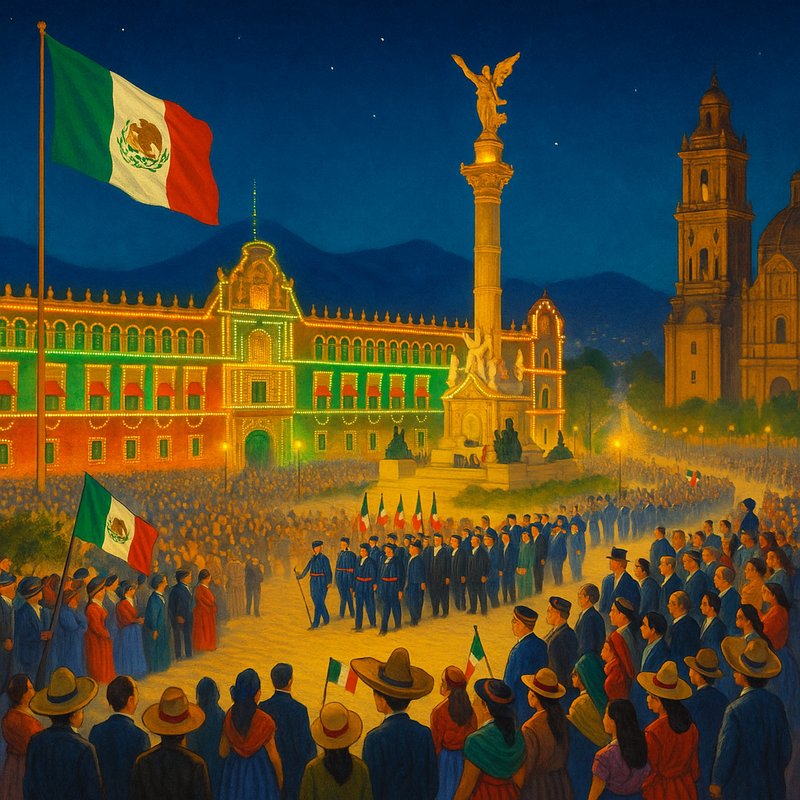
The centennial celebrations actually began on September 15–16, 1910, not September 22. Porfirio Díaz launched weeks of elaborate festivities to transform Mexico's 1810 independence rebellion into proof of his regime's modernizing success. You'll see how he used grand parades, electric illumination of the National Palace, and international delegations to project a unified, modern Mexico onto the world stage. There's far more to this extraordinary political spectacle than the opening night alone.
Key Takeaways
- Mexico's centennial celebrations in September 1910 marked 100 years since the 1810 independence rebellion led by Miguel Hidalgo.
- Porfirio Díaz orchestrated grand festivities, including parades, monument unveilings, and electric illumination of the National Palace.
- The Gran Desfile Histórico parade dramatized three historical phases: conquest, colonial rule, and independence, promoting a liberal national narrative.
- The Independence Column on Paseo de la Reforma was unveiled as a permanent symbol of Mexico's centennial milestone.
- International delegations from the United States, Europe, and Asia attended, reinforcing Mexico's image as a modern, unified nation.
Why 1810 Made 1910 Mexico's Most Symbolic Year
By 1910, a century later, Porfirio Díaz's government recognized what that anniversary meant. You can think of 1910 as the moment when the state took deliberate ownership of that founding story.
Officials framed the centennial as proof that Mexico had evolved from violent insurgency into a modern, unified nation. The 1810 rebellion didn't just start a war—it gave 1910 its extraordinary symbolic weight. That same era saw other nations consolidating their international identities, much as Belgium had done after gaining independence and establishing Brussels as headquarters of major institutions like NATO and the European Union.
Why Díaz Made Independence Day a National Showcase?
Ambition shaped how Porfirio Díaz approached the centennial. He didn't treat Independence Day as a simple anniversary — he transformed it into political theater designed to legitimize his decades-long rule. By staging grand parades, illuminating the National Palace with electric lights, and revealing the Independence Column on Paseo de la Reforma, Díaz sent a clear message: Mexico had arrived among modern nations.
You can see his strategy clearly when you examine the international dimension. Foreign delegations from Europe, the United States, and Asia attended, turning the celebrations into an economic spectacle that attracted global attention and investment confidence. Díaz used patriotic memory not to honor the past alone, but to reinforce his government's claim that order and modernization were inseparable from Mexican national identity. Just one year later, the world would be shocked by tragedies like the Triangle Shirtwaist Factory fire, which exposed how industrialization's darker side — locked doors, poor safety measures, and exploited immigrant workers — undermined the very progress that leaders like Díaz so eagerly celebrated.
The Grand Historical Parade and the Story It Staged
The gran desfile histórico didn't just entertain the estimated 100,000 people packed into the Zócalo on 15 September 1910 — it taught them a state-approved version of their own history. The parade moved through three distinct phases: conquest, Spanish colonial rule, and independence. Each section relied on costume authenticity to signal historical credibility, dressing participants in period-accurate garments that made abstract history feel tangible.
The stage choreography guided crowds through a liberal reading of Mexico's past, one that downplayed conflict and emphasized inevitable progress toward nationhood. Morelos emerged as a mestizo symbol, representing unity rather than division. You'd have watched history being actively shaped in front of you — not just remembered, but carefully curated to serve the Porfirian vision of order and modernization.
The Independence Column: Mexico City's 1910 Centennial Monument
While the historical parade staged Mexico's past in motion, Porfirio Díaz's government wanted something permanent — a monument that would outlast the festivities and anchor the centennial's meaning in stone and bronze. That monument was the Independence Column on Paseo de la Reforma.
You'd recognize its sculptural symbolism immediately: a golden winged Victory crowning a tall column, with bronze figures of independence heroes at its base. It wasn't built without friction — construction controversies delayed progress, and critics questioned its costs and European aesthetic influences.
Still, the government pushed forward, and the Column was inaugurated as part of the centennial ceremonies. It became the celebration's most enduring legacy, transforming a boulevard into a patriotic landmark that Mexicans still gather around every September 15th.
How Mexico City Was Staged as a Modern Capital for the 1910 Centennial
Beyond the parades and monuments, Díaz's government transformed Mexico City itself into a statement of national ambition. If you'd walked through the capital that September, you'd have seen a city deliberately staged through urban choreography — streets cleaned, facades restored, and public spaces arranged to project order and sophistication.
The National Palace and the Cathedral blazed with electric illumination for the first time, turning familiar landmarks into symbols of modern progress. Paseo de la Reforma became a corridor of national pride, anchored by the newly revealed Independence Column.
Every detail signaled Mexico's readiness to stand among modern nations. The city wasn't just hosting a celebration — it was the celebration, performing prosperity and unity for domestic crowds and foreign delegations watching closely from around the world.
How Foreign Nations Participated in Mexico's 1910 Centennial?
Mexico's 1910 centennial wasn't just a domestic affair — foreign delegations from the United States, Europe, and Asia made the journey to Mexico City, turning the celebrations into a showcase of cosmopolitan diplomacy. If you'd attended, you'd have witnessed diplomatic exhibitions from nations keen to strengthen ties with Porfirio Díaz's government.
Japan's contribution stood out. On September 2, 1910, Japan opened a major exhibition of Japanese products in Mexico City, with Díaz, his cabinet, and the Japanese ambassador present at the opening. The foreign press covered these displays extensively, amplifying Mexico's image as a modern, internationally connected nation. Díaz deliberately used the centennial to position Mexico among the world's progressive states, and foreign participation helped him make that case convincingly.
How Mexico Sold the World on the Mestizo Nation in 1910?
The 1910 centennial didn't just mark a century of independence — it pushed forward a carefully crafted national identity rooted in mestizaje, the blending of indigenous and Spanish heritage. Porfirio Díaz's government used the celebrations to broadcast racial narratives that positioned Mexico as a unified, modern nation built from diverse origins.
You'd have seen this message embedded everywhere — in the gran desfile histórico's cultural performances, in the elevation of figures like Morelos as mestizo icons, and in the carefully staged urban spaces meant to impress both domestic crowds and foreign guests. The centennial framed mestizaje not as tension but as triumph, linking 1810's insurgency to a forward-looking national story. Mexico wasn't just celebrating the past — it was selling the world a vision of its future.
What the 1910 Centennial Established as Mexico's Official Historical Memory?
What the 1910 centennial locked in wasn't just a date on a calendar — it was a complete interpretive framework for how Mexicans would remember their independence.
Through deliberate ceremonial choreography, Díaz's government shaped collective memory while engineering collective amnesia around inconvenient truths. You can trace that influence through three lasting imprints:
- Morelos and Hidalgo became the official faces of mestizo national identity.
- The Independence Column turned abstract patriotism into permanent stone.
- The liberal historical narrative displaced competing regional and indigenous interpretations.
These weren't accidental outcomes.
The state engineered them through parades, monuments, and ritual. What you see in Mexico's twentieth-century history books largely reflects what Porfirian planners decided the nation needed to believe about itself in 1910.