

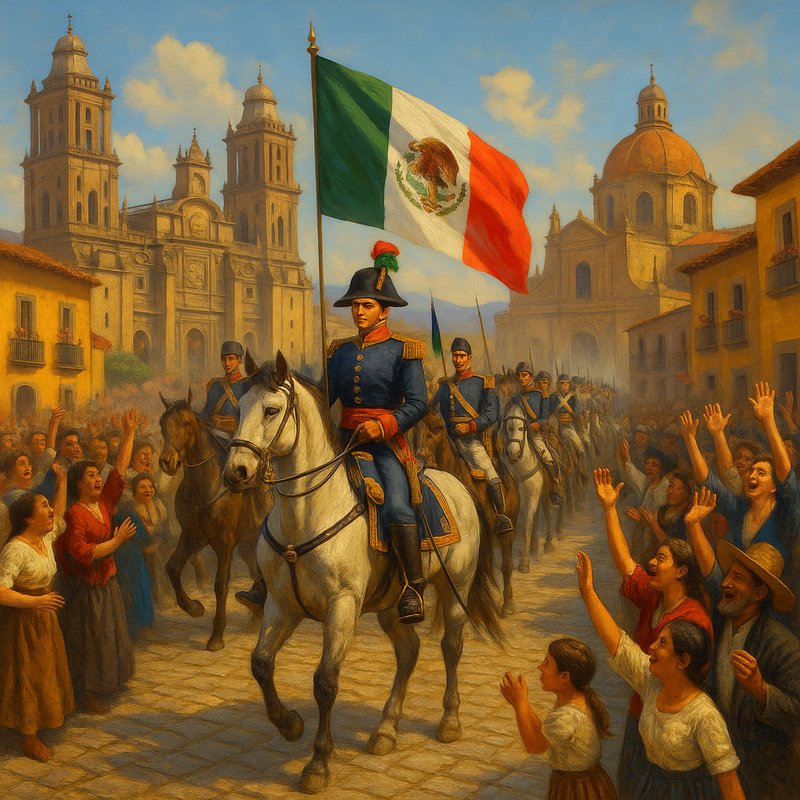
The date you're looking for isn't September 21 — it's actually September 27, 1821. That's when the Army of the Three Guarantees marched into Mexico City, ending over three centuries of Spanish colonial rule. The army formed from an unlikely alliance between royalist Agustín de Iturbide and insurgent Vicente Guerrero, united under three principles: independence, religion, and unity. If you want the full story behind how it all unfolded, there's much more to uncover.
Key Takeaways
- The Army of the Three Guarantees entered Mexico City on September 27, 1821, not September 21, ending over three centuries of Spanish colonial rule.
- The army was formed from the alliance between royalist Agustín de Iturbide and insurgent Vicente Guerrero following the Plan of Iguala.
- Spanish resistance collapsed without a final battle due to deteriorated morale, logistical breakdown, and prior civilian negotiations.
- Iturbide led a ceremonial procession into the capital amid cheering crowds, giving the new government immediate political legitimacy.
- The following day, September 28, 1821, the Act of Independence was signed, establishing the Provisional Governing Council and Regency.
What Was the Army of the Three Guarantees?
The Army of the Three Guarantees, or Ejército Trigarante, was a unified military force born from an unlikely alliance between royalist troops under Agustín de Iturbide and insurgent forces led by Vicente Guerrero. Its name reflected its founding principles: independence, religion, and unity. The Plan of Iguala formalized this coalition, giving it both political direction and legitimacy.
The army's social composition was deliberately broad, drawing soldiers from across racial and class lines to project national unity rather than faction. Its military symbolism was equally intentional — the tricolor flag and unified ranks signaled that Mexico's independence movement had transcended its earlier divisions. You can think of it as a force designed not just to fight, but to represent a new national identity taking shape.
The Plan of Iguala: What Mexico Was Actually Fighting For
Announced on February 24, 1821, the Plan of Iguala laid out three core guarantees that gave the Army of the Three Guarantees its name: Mexican independence from Spain, the protection of the Catholic Church's privileged status, and the equal treatment of both Spanish-born and Mexican-born inhabitants.
These weren't radical demands. Iturbide designed the plan to appeal broadly by emphasizing religious protections and social hierarchy preservation, reassuring conservative elites that independence wouldn't dismantle existing institutions. That strategic framing proved effective. Royalists and insurgents who'd spent years fighting each other found enough common ground in the plan to unite. You can think of Iguala less as a revolutionary manifesto and more as a calculated compromise that made independence politically achievable without triggering wholesale social collapse.
The Alliance Between Iturbide and Guerrero That Changed Mexico
Making the Plan of Iguala work on paper was one thing—actually uniting former enemies under it was another. Agustín de Iturbide, a royalist commander, and Vicente Guerrero, a hardened insurgent leader, had spent years fighting on opposite sides. Yet in early 1821, they chose cooperation over conflict.
You can think of their alliance as the foundation of broader regional alliances that pulled together factions previously too divided to act decisively. Social reconciliation wasn't just a political slogan—it became a practical strategy. By joining forces, Iturbide and Guerrero signaled to royalists, insurgents, and neutral parties alike that independence was achievable without endless bloodshed.
Their coalition rapidly expanded the Army of the Three Guarantees, creating the unified military force that ultimately marched into Mexico City and ended Spanish rule. Similarly, Jim Thorpe's ability to compete across multiple disciplines—winning gold medals in both the pentathlon and decathlon at the 1912 Stockholm Olympics—demonstrated how exceptional individuals can unite seemingly incompatible strengths into a single, dominant force.
Iturbide, Guerrero, and O'Donojú: The Three Men Who Closed the War
Three men, each representing a different faction, effectively closed the Mexican War of Independence. You can trace Iturbide's ambition through every calculated move he made—from negotiating the Plan of Iguala to leading the Army of the Three Guarantees into Mexico City. He wanted power, and he built a coalition to get it.
Guerrero's legacy, however, runs deeper. He'd kept the insurgency alive when others quit, and his alliance with Iturbide gave the independence movement the unity it needed to finally succeed.
Then there's O'Donojú, Spain's last real authority in New Spain. Rather than fight a losing battle, he signed the Treaty of Córdoba and accepted the inevitable. Together, these three men didn't just end a war—they built a new nation. Just as Mexico's founding required dismantling existing power structures to establish new rights, later legislative milestones like Title IX's sex discrimination prohibition would demonstrate how formal legal frameworks can reshape institutions and expand opportunities for those previously excluded.
Juan O'Donojú and the Treaty of Córdoba
When O'Donojú arrived in New Spain in the summer of 1821, he walked into a colony already lost. Rather than fight the inevitable, his diplomatic maneuvering led him to sign the Treaty of Córdoba with Iturbide, accepting independence and reshaping the legal implications of Spanish authority overnight.
- Spain had lost effective military control across most of New Spain
- O'Donojú held no realistic power to reverse the independence movement
- The treaty formally recognized the Mexican Empire as a sovereign state
- It voided Spanish claims to govern the territory administratively
- O'Donojú's signature accelerated the Army of the Three Guarantees' peaceful entry into Mexico City
You can see why this moment mattered — one signature dismantled three centuries of colonial rule without a final battle.
The Army of the Three Guarantees Enters Mexico City: September 27, 1821
On September 27, 1821, the Army of the Three Guarantees marched into Mexico City and ended over three centuries of Spanish colonial rule in a single, peaceful stroke.
You'd have witnessed Agustín de Iturbide leading a ceremonial procession through streets filled with urban celebrations, crowds cheering the arrival of an independent Mexican state. The moment carried enormous symbolic weight—the war had lasted eleven years, and yet the capital fell without violence.
Iturbide's coalition, built through his alliance with insurgent leader Vicente Guerrero and legitimized by the Treaty of Córdoba, had unified enough military and political force to make Spanish resistance collapse entirely.
The following day, governing institutions took shape, and Mexico formally converted from the Viceroyalty of New Spain to an independent nation.
How Spain's Resistance in the Capital Collapsed Without a Battle
The peaceful march you witnessed into Mexico City didn't happen by accident—Spain's resistance had already crumbled before Iturbide's forces reached the capital's gates. Civilian negotiations and a logistical breakdown gutted any real Spanish fighting capability long before September 27, 1821.
- O'Donojú recognized he commanded insufficient forces to hold the city
- The Treaty of Córdoba legally neutralized Spanish authority beforehand
- Supply lines and troop morale had deteriorated across New Spain
- Local civilian negotiations between city leaders and Iturbide's representatives removed remaining political obstacles
- Royalist commanders couldn't sustain a defense after the logistical breakdown stripped their resources
Spain's position had become untenable. Rather than spilling blood in a doomed urban battle, the remaining Spanish authorities stepped aside, allowing the Army of the Three Guarantees to enter unopposed.
The Act of Independence and the Provisional Government Established on September 28
Just one day after the Army of the Three Guarantees marched into Mexico City, Mexico's new leaders moved quickly to formalize what the army had won on the battlefield. On September 28, 1821, they signed the Act of Independence, creating the legal framework that officially ended Spanish rule. Leaders established a Provisional Governing Council and a Regency, with Iturbide heading the new government.
You can think of ceremonial symbols like flags and public proclamations as the visible face of this political transformation. Civic celebrations erupted across the capital as ordinary people felt the weight of the moment. The new state still needed international recognition to secure its standing, but the institutional foundation had been laid within hours of the army's arrival.
What the Army's Entry Meant for Mexico's New Government
Marching into Mexico City on September 27, 1821, the Army of the Three Guarantees handed Mexico's new leaders something no treaty alone could've provided: undeniable political legitimacy backed by military force. You can see how that leverage immediately shaped the government's priorities around social integration and economic reform.
- The Provisional Governing Council gained credibility through the army's visible, peaceful authority
- Social integration became achievable as royalists and insurgents unified under one command
- Economic reform discussions could begin without active military conflict disrupting governance
- The Regency established structured leadership backed by the army's recognized power
- Public confidence rose, giving new institutions room to govern effectively
Without that entry, Mexico's fragile new government would've faced legitimacy challenges no political document could've resolved alone.
Why September 27 Is the Consummation Date, Not September 16
Once the army's entry gave Mexico's new government its political footing, you can understand why September 27 carries more historical weight than September 16. September 16 marks when Father Hidalgo rang his bell in 1810 and launched the uprising, so it anchors national symbolism and civic rituals around the war's emotional starting point. Mexico rightly honors that moment.
But September 27, 1821 is when the Army of the Three Guarantees actually marched into Mexico City, Spanish authority collapsed, and independence became a concrete political reality. September 16 represents a declaration of intent; September 27 represents the fulfilled outcome. Calling September 27 the consummation date isn't diminishing September 16—it's distinguishing between the spark that started an eleven-year war and the moment that ended it.