

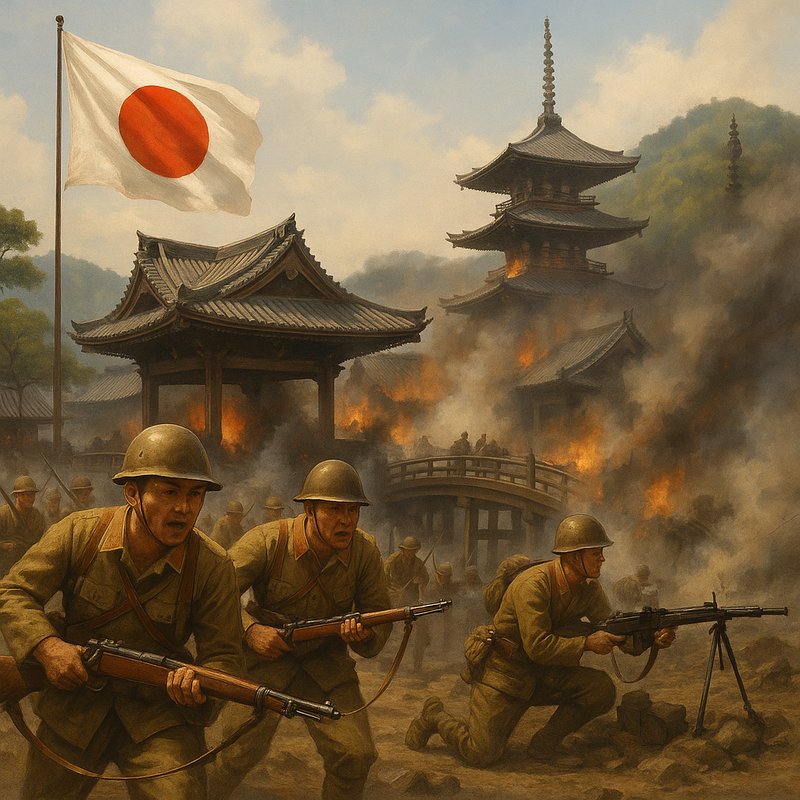
By September 21, 1937, you're witnessing a war that's outgrown any simple definition. What started as a bridge skirmish in July had torn through North China's provincial capitals and ignited brutal urban warfare in Shanghai. Japan's forces pushed relentlessly forward, while China's underprepared military scrambled to respond. The conflict had become a national struggle, not a border dispute. Keep exploring, and you'll uncover exactly how this war reshaped an entire continent.
Key Takeaways
- By September 1937, Japan had seized multiple North China provincial capitals, demonstrating rapid territorial expansion following the July Marco Polo Bridge Incident.
- The Battle of Shanghai shifted the conflict from North China into Central China, broadening the war's geographic scope significantly.
- China's military unpreparedness, lacking mechanized and armored forces, allowed Japanese advances to accelerate across multiple fronts simultaneously.
- Japan's strategy of capturing key cities and railway lines enabled swift momentum, preventing Chinese forces from effectively regrouping.
- Both governments faced mounting pressure, making negotiated restraint increasingly unlikely and cementing transition into full-scale national war.
Japan's Expanding Presence in China Before 1937
Japan's imperial ambitions in China didn't begin in 1937—they'd been building for over a decade. By the time you reach 1931, Japan had already begun expanding its foothold on Chinese soil, using both military pressure and Japanese diplomacy to tighten its grip on the region.
Economic motivations drove much of this push—Japan wanted access to China's vast natural resources and markets to fuel its growing industrial machine. You can trace a clear line from these early moves to the full-scale war that erupted in 1937.
Each territorial gain emboldened Japan's leadership further, making negotiated restraint increasingly unlikely. What looked like calculated expansion was actually a slow-moving collision course, one that China's Nationalist government found itself dangerously underprepared to stop when open conflict finally arrived.
How the Marco Polo Bridge Incident Ignited Full-Scale War
On the night of July 7, 1937, a single military skirmish near Beijing set off a chain of events neither side could walk back. The Marco Polo Bridge Incident collapsed any remaining diplomatic ground and reshaped Conflict Dynamics across the entire region.
Here's what you need to understand about the escalation:
- Japanese and Chinese troops clashed near the Marco Polo Bridge.
- Local tensions quickly outgrew regional control.
- Both governments faced pressure to respond forcefully.
- Negotiations broke down as fighting widened.
- Full-scale war became unavoidable by late July 1937.
You're watching a border dispute transform into sustained national conflict.
Neither side declared war immediately, yet large-scale combat was already dictating terms.
The incident didn't just start a battle — it started a war.
China's Military Weaknesses at the Start of the Conflict
When full-scale war broke out in 1937, China wasn't ready for it. You'd find a military stretched thin, plagued by military disorganization, and struggling with a severe lack of resources.
The Nationalist government hadn't built a modern war machine capable of matching Japan's industrial and military strength. China entered the conflict with no mechanized divisions and only minimal armored forces.
You'd see local commanders operating with little coordination, making unified resistance difficult from the start. The government scrambled to mobilize after hostilities escalated, but preparation simply hadn't kept pace with the crisis.
Guerrilla units formed quickly across affected regions, later aligning with either Nationalist or Communist forces. These irregular fighters became essential precisely because China's conventional military couldn't carry the burden of resistance alone.
How Japan Pushed Through North and Central China
Japanese forces wasted little time pushing beyond the Beijing area after hostilities erupted in July 1937.
Their Japanese strategy centered on controlling key cities and railway lines to fracture China's defenses quickly.
Urban warfare became brutal and decisive, especially as fighting spread into Central China.
You'll notice the pattern across their advance:
- Captured provincial capitals across North China within months
- Seized major railway corridors to cut off Chinese supply lines
- Shifted operations toward Shanghai, escalating urban warfare dramatically
- Pushed deeper into Central and Eastern China by late 1937
- Used rapid momentum to prevent Chinese forces from regrouping
Why the Battle of Shanghai Was a Turning Point in 1937
The Battle of Shanghai transformed what had started as regional fighting into a full-scale national war. When you look at the strategies employed by both sides, you can see how this battle forced Japan to commit far greater resources than it had initially planned.
China's decision to fight hard at Shanghai signaled that it wouldn't surrender its major cities without a serious contest.
You'll also notice that propaganda efforts intensified during this battle. The Nationalist government used Shanghai's defense to rally domestic and international support, framing China's resistance as a fight for survival.
The battle shifted the war beyond North China, pulling Central China directly into the conflict. By the time Shanghai fell, the war's scale had changed permanently, setting the stage for even broader Japanese advances.
How the War Spread Across China by Late 1937
After Shanghai fell, Japan's military pushed its campaigns deep into China's interior, seizing key provincial capitals and cutting off major transportation corridors across North and Central China.
You can trace this expansion through several critical developments:
- Japanese forces captured major urban centers across North China
- Urban resistance collapsed under overwhelming Japanese firepower
- Chinese units shifted toward guerrilla tactics as conventional defenses failed
- Railway lines became primary Japanese strategic objectives
- Fighting extended across Eastern China by December 1937
These moves transformed a regional conflict into a nationwide war. China's lack of mechanized forces made holding fixed positions nearly impossible, forcing commanders to adapt quickly. Japanese columns advanced as far as 40 kilometers daily, frequently outpacing their own supply lines as they drove toward Nanjing by late November 1937.