

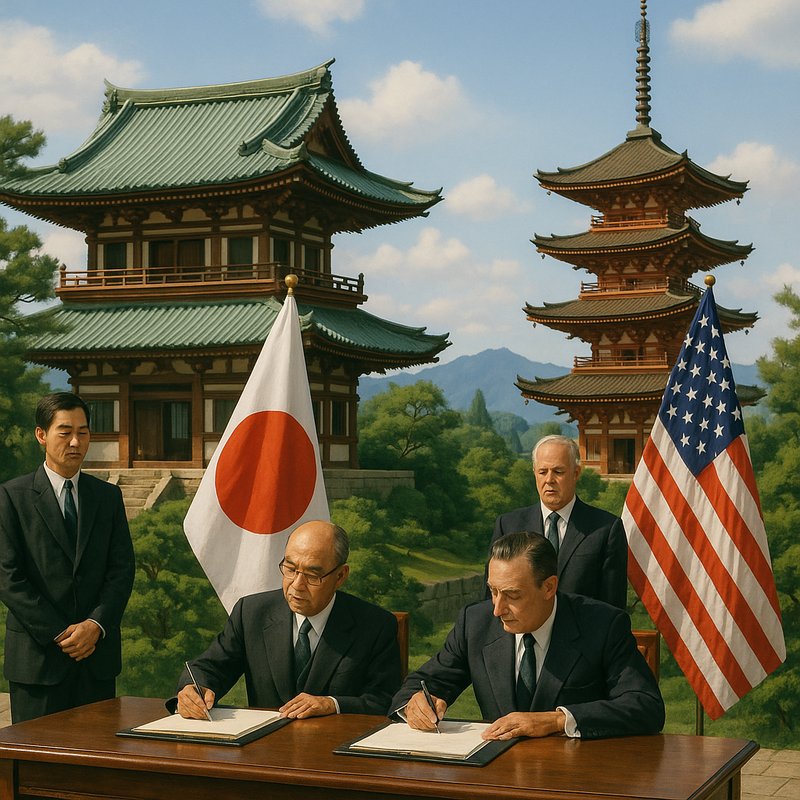
If you're searching for September 22, 1951, you'll want to adjust that date — Japan actually signed its landmark security treaty with the United States on September 8, 1951, in San Francisco. The agreement allowed U.S. military bases on Japanese soil and positioned Japan as a key ally during Cold War tensions with the Soviet Union and China. It was a defining moment in Japan's postwar foreign policy, and there's much more to the story.
Key Takeaways
- The U.S.–Japan Security Treaty was signed on September 8, 1951, in San Francisco, not September 22, 1951.
- The treaty allowed U.S. military bases on Japanese soil following the end of the American occupation.
- It was signed alongside the San Francisco Peace Treaty, which formally restored Japanese sovereignty.
- The treaty was asymmetrical, lacking a mutual defense clause obligating the U.S. to defend Japan.
- Japan was prohibited from granting military base rights to other nations without prior U.S. approval.
What Was the 1951 U.S.–Japan Security Treaty?
On September 8, 1951, the United States and Japan signed a security treaty in San Francisco that would reshape the region's Cold War landscape for decades.
You can understand its treaty significance by looking at what it actually did: it allowed the U.S. to maintain military bases on Japanese soil after the occupation ended in 1952.
That arrangement wasn't accidental. It reflected a deliberate military strategy to counter Soviet and Chinese influence across the Far East.
Japan couldn't grant base rights to any other foreign power without U.S. consent.
The treaty was asymmetrical—Japan took on restrictions while the U.S. gained strategic positioning.
It was signed the same day as the San Francisco Peace Treaty, linking Japan's restored sovereignty directly to its new security obligations.
Why Japan Needed a Security Alliance After World War II
That treaty didn't emerge from a vacuum—Japan's postwar situation made some form of security arrangement nearly unavoidable.
After World War II, Japan faced serious postwar challenges that reshaped its strategic position entirely. Article 9 of Japan's new constitution renounced war and prohibited maintaining offensive military forces.
That left the country with virtually no capacity to defend itself independently.
Meanwhile, the Cold War was intensifying. China had fallen to communist forces in 1949, and the Korean War was already underway by 1951.
The Soviet Union posed additional pressure across the region.
Japan's security needs were real and immediate. You couldn't realistically restore Japanese sovereignty without addressing the defense vacuum it would create.
Partnering with the United States offered Japan stability, military protection, and a path forward during an unpredictable and dangerous period.
The Cold War Pressures Behind the 1951 Security Treaty
Those pressures didn't exist in isolation—the Cold War was actively reshaping every strategic calculation the United States made in the Pacific.
You can see how the Cold War Context made Japan's position critical. China had fallen to Communist forces in 1949, and the Korean War was already underway by 1950. The Soviet Union posed a direct ideological and military threat across the region.
The United States needed a reliable foothold in the Pacific, and Japan fit that role precisely. Through this Strategic Alliance, Washington secured military bases while offering Japan a security umbrella it couldn't build independently under Article 9 of its constitution.
Both nations recognized the arrangement as necessary—Japan needed protection, and the United States needed geographic positioning to counter Soviet and Chinese expansion.
What the 1951 Treaty Actually Required of Both Nations
With Cold War pressures setting the stage, the actual text of the 1951 treaty reveals just how uneven the arrangement was. Japan accepted a continued U.S. military presence on its territory, granted Americans base access, and agreed not to offer similar rights to any other foreign power without U.S. consent. Those were significant treaty obligations falling squarely on Japan's side.
The United States, however, didn't commit to defending Japan if it came under attack. You'd expect a mutual defense clause, but it wasn't there.
American forces could use Japanese bases for regional security across the Far East, yet Japan received no guaranteed protection in return. The arrangement clearly favored U.S. strategic interests, leaving Japan in a dependent position with limited security assurances.
How the Treaty Fit Into Japan's Peace Constitution
Japan's peace constitution created an immediate tension with the security treaty, and understanding that tension helps explain why the arrangement looked so unusual on paper. Article 9 committed Japan to renouncing war and maintaining no offensive military capacity.
Yet Japan's sovereignty required some form of external security once the occupation ended. The treaty resolved that contradiction by letting U.S. forces handle defense responsibilities while Japan avoided rebuilding a traditional military.
Security implications were significant — Japan fundamentally outsourced its defense posture to Washington, threading the needle between constitutional limits and Cold War realities.
You'll notice Japan retained the right to self-defense under the United Nations Charter, which gave the arrangement just enough legal grounding to coexist with Article 9 without directly violating its core commitment.
Why Critics Called the 1951 Security Treaty One-Sided
Critics called the 1951 security treaty one-sided because it handed the United States enormous strategic advantages while offering Japan relatively little in return.
When you examine the one sided critique, the treaty implications become clear:
- The U.S. gained the right to station forces across Japan indefinitely.
- Japan couldn't grant any foreign power military rights without U.S. approval.
- The U.S. faced no clear obligation to defend Japan if attacked.
Japan fundamentally traded sovereignty over its own security decisions for a loose protective arrangement.
You can see why critics viewed this as deeply unequal. The imbalance became so politically damaging that the treaty required a full revision by 1960, adding mutual defense commitments that the original agreement had conspicuously left out.
How the 1960 Revision Transformed the U.S.–Japan Alliance
By 1960, the political pressure from the treaty's glaring asymmetry forced a full renegotiation. The 1960 revision reshaped the entire alliance by adding mutual security commitments that the original lacked. Under the updated framework, the United States explicitly agreed to defend Japan if attacked, while Japan continued providing base access for American forces.
You can trace today's alliance directly to that revision. It transformed a one-sided arrangement into a bilateral defense partnership with clearer legal obligations on both sides. The new security commitments gave Japan a stronger foundation for its postwar foreign policy and reduced public resentment over the perceived imbalance.
The revised treaty didn't just patch the original—it replaced its core logic. That 1960 framework remains the legal backbone of the U.S.–Japan alliance today.
How the Treaty Reshaped Security Across the Pacific
The 1960 revision didn't just rebalance a bilateral relationship—it sent a clear signal across the entire Pacific. Its strategic implications rippled outward, reinforcing regional stability during one of the Cold War's most volatile periods.
You can see its impact in three key areas:
- Deterrence – U.S. bases in Japan created a credible military presence that discouraged Soviet and Chinese aggression.
- Alliance credibility – Other regional partners watched Washington's commitment to Tokyo as a measure of U.S. reliability.
- Strategic positioning – Japan became a forward operating hub for U.S. forces across the Pacific theater.
The treaty didn't just protect Japan—it anchored an entire security architecture that shaped how nations across the region calculated risk and aligned their foreign policies.