

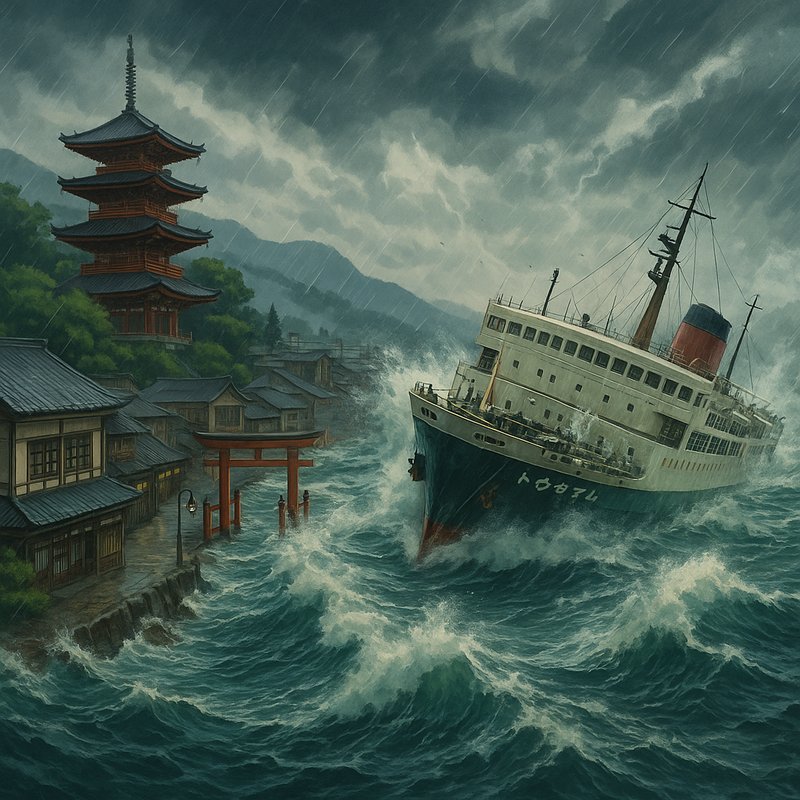
On September 26, 1954, you're looking at one of Japan's worst maritime disasters. Typhoon Marie battered the Tsugaru Strait with violent winds and massive waves, sending the 3,899-ton train ferry Tōya Maru to the bottom near Nanaehama. The ship capsized in roughly 17 minutes, killing over 1,150 of the 1,309 people aboard. Only 150 survivors made it out. The full story behind that night reveals far more than the numbers alone can tell.
Key Takeaways
- On September 26, 1954, the Tōya Maru ferry capsized near Nanaehama at approximately 10 p.m. during Typhoon Marie.
- The 3,899-ton train ferry operated on the Hakodate–Aomori crossing through the Tsugaru Strait between Honshū and Hokkaidō.
- Of the 1,309 people aboard, approximately 1,159 perished, with only 150 survivors rescued amid chaotic conditions.
- Engine failure and uncontrollable flooding caused the vessel to capsize in roughly 17 minutes during the violent storm.
- The disaster prompted Japan to overhaul maritime safety regulations and influenced the eventual construction of the Seikan Tunnel.
What Was the Toya Maru and What Route Did It Run?
The Tōya Maru was a 3,899-ton train ferry built for Japanese National Railways, running the Hakodate–Aomori crossing through the Tsugaru Strait between Hokkaidō and Honshū.
If you think about how crucial this route was, you'd understand why ferry operations ran continuously — the crossing served as a significant link for rail and passenger transport connecting Japan's two main islands.
Before the Seikan Tunnel opened decades later, you'd no better option than these ferries to move people and cargo between Honshū and Hokkaidō. The Tōya Maru was part of the broader Seikan ferry system, making regular crossings through one of Japan's most demanding stretches of water.
That geographic reality made the route indispensable — and on September 26, 1954, fatally dangerous.
How Severe Was the Typhoon That Sank the Toya Maru?
What made that crossing so deadly on September 26, 1954, wasn't just bad weather — it was Typhoon Marie, a storm violent enough that Japan permanently named it the Tōya Maru Typhoon.
The typhoon's strength caught northern Japan hard, racing northeast after tearing through Kyushu and Chugoku. By the time it reached Hokkaidō, it was driving gale-force winds and enormous waves across the Tsugaru Strait.
The storm impact stretched far beyond the water — it caused widespread destruction across the region. Several other Seikan ferries suffered damage or sank during the same storm.
Total deaths from the typhoon across land and sea exceeded 3,000 in some accounts. You can't separate the Tōya Maru disaster from the typhoon itself — the storm made survival nearly impossible.
The Night the Toya Maru Went Down
Somewhere around 10 p.m. on September 26, 1954, the Tōya Maru capsized near Nanaehama — and it was over in roughly 17 minutes.
You can piece together what happened through eyewitness accounts from the 150 survivors: water forced its way in, the steam engines died, and the ship lost all ability to fight the sea. Once power failed, the vessel had no chance against Typhoon Marie's waves.
Questions about storm preparedness followed immediately. Operators had made the call to keep the ferry in service despite worsening conditions, and that decision cost over 1,150 people their lives.
The Tsugaru Strait became a graveyard that night, and Japan's deadliest maritime disaster forced the entire country to confront how badly the warning systems and protocols had failed.
Why Did the Toya Maru Sink So Fast?
Seventeen minutes is brutally fast for a ship of nearly 4,000 tons to go under, and the sequence of failures explains why.
Once you understand the chain of events, the speed makes terrible sense. Typhoon Marie's weather factors hit hard — gale-force winds and steep waves overwhelmed the hull once the Toya Maru left the harbor's protection.
Water flooded in, and that alone would've been survivable if the engines had kept running. They didn't.
When the steam engines stopped, the crew lost all ability to steer into the waves or manage the flooding. The ship became helpless and rolled.
Operational decisions made before departure also played a role — the ferry shouldn't have been out there at all. Those two failures together made seventeen minutes almost inevitable.
How Many People Died in the Toya Maru Disaster?
The death toll from the Toya Maru disaster is grimly contested. Japanese National Railways announced in September 1955 that 1,153 people had died, but fatality estimates vary across sources. The most frequently cited figures report 1,159 deaths out of 1,309 people aboard, leaving only 150 survivors. Some accounts push the number as high as 1,170.
You'll find that the uncertainty stems from last-minute boardings and canceled tickets, making an exact headcount nearly impossible.
Survivor accounts further complicate the picture, since witnesses recalled chaotic conditions that left little time to track who was actually on the vessel.
Regardless of which figure you accept, the Toya Maru remains the deadliest maritime disaster in Japanese history, claiming well over a thousand lives in a single night.
Was the Toya Maru the Only Ferry That Sank That Night?
While the Toya Maru's sinking dominates the historical record, it wasn't the only ferry lost that night. Typhoon Marie struck multiple vessels crossing the Tsugaru Strait, turning September 26, 1954, into a catastrophic night for Japanese maritime history.
The broader ferry disaster response revealed serious gaps in storm preparedness across the entire Seikan ferry system.
Beyond the Tōya Maru casualties, here's what you should know:
- Four additional ferries were reportedly sunk or severely damaged during the same typhoon.
- Maritime deaths exceeded 1,430 across all related ferry accidents that night.
- Total typhoon fatalities surpassed 3,000 when combining land and sea losses.
The scale of that single storm reshaped how Japan approached ferry safety regulations permanently.
What Changed in Japanese Maritime Safety After the Disaster?
After the Tōya Maru disaster, Japan didn't quietly adjust a regulation or two — it overhauled how the country thought about ferry safety entirely.
The losses forced Japanese National Railways and maritime authorities to confront hard truths about departure decisions during severe weather. You can trace the disaster's influence directly to stricter safety regulations governing when ferries could and couldn't sail through the Tsugaru Strait.
Authorities also recognized that better maritime training could mean the difference between survival and catastrophe when conditions turned deadly fast.
Beyond paperwork and procedures, the disaster pushed Japan toward eventually building the Seikan Tunnel, eliminating the dangerous strait crossing altogether.
The Tōya Maru didn't just change rules — it permanently reshaped how Japan balanced transportation demand against human lives.