

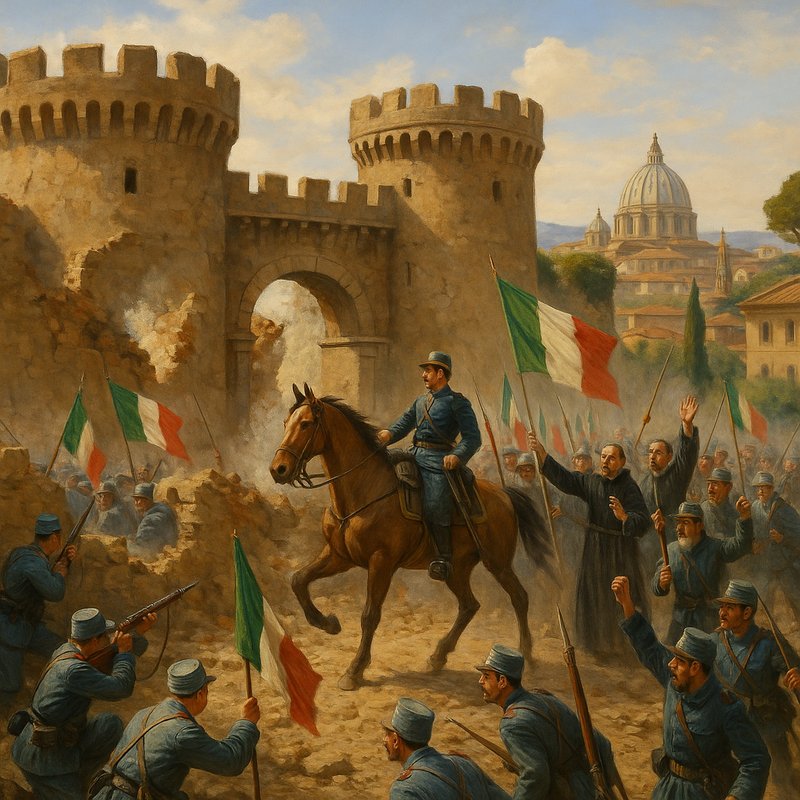
On September 20, 1870, Italian troops breached Rome's Aurelian Walls at Porta Pia, completing the nation's unification. You can trace this victory back to years of failed attempts, including Garibaldi's defeats at Aspromonte in 1862 and Mentana in 1867. The Franco-Prussian War pulled French troops away, leaving Rome undefended. Pope Pius IX ordered minimal resistance, limiting casualties. A plebiscite soon after confirmed Romans wanted to join Italy. There's much more to this pivotal story ahead.
Key Takeaways
- On September 20, 1870, Italian troops breached the Aurelian Walls at Porta Pia, capturing Rome and completing national unification.
- The Franco-Prussian War forced France to withdraw troops protecting Pope Pius IX, creating the opportunity for Italy's advance.
- Pope Pius IX ordered minimal resistance, limiting casualties, then declared himself a Vatican prisoner, rejecting Italian authority.
- A plebiscite on October 2 showed overwhelming citizen support, leading to Rome's formal annexation on October 9, 1870.
- Rome was officially designated Italy's capital on February 3, 1871, fulfilling the Risorgimento movement's central goal.
Why Unification Couldn't Be Complete Without Rome
Rome wasn't just another city on Italy's unification checklist—it was the symbolic heart of the entire Risorgimento movement. You can't fully grasp Italian identity without understanding Rome's central role in shaping the peninsula's cultural and political soul.
For nationalists, claiming Rome meant claiming legitimacy.
Without Rome, Italy's territorial sovereignty remained incomplete. Other regions had already joined the Kingdom of Italy, but the Papal States kept Rome locked away under Church authority, backed by French military presence.
Every attempt to take the city—including Garibaldi's failed efforts in 1862 and 1867—only reinforced how essential Rome was to finishing what unification started.
Rome represented the final piece. Without it, Italy existed as a nation in name only, lacking both its historical capital and its political foundation.
Garibaldi's Failed Attempts to Capture Rome Before 1870
Before 1870, Giuseppe Garibaldi made two bold attempts to seize Rome and failed both times.
In 1862, you can trace his first campaign to the Battle of Aspromonte, where Italian royal forces stopped him in his tracks. Garibaldi's strategies relied on volunteer fighters and nationalist momentum, but he lacked the diplomatic cover and military strength needed to overcome French protection of the Pope.
His 1867 attempt collapsed at Mentana, where French and papal troops crushed his forces decisively. Military limitations plagued both campaigns — without a withdrawing French garrison, no volunteer army could realistically breach Rome's defenses.
These failures proved that capturing Rome required a coordinated national army, not irregular forces, setting the stage for the 1870 campaign that finally succeeded.
Why the Franco-Prussian War Left Rome Undefended in 1870
When Napoleon III pulled French troops from Rome in 1870 to fight Prussia, he inadvertently handed Italian nationalists the opening they'd been waiting for. The Franco Prussian Impact on Rome's defensibility was immediate and decisive. Without French soldiers guarding Pius IX, the city lost its most formidable military deterrent.
You have to understand the Military Strategics at play here. France had long shielded papal temporal authority in Lazio, making direct Italian intervention virtually impossible.
Once Napoleon redirected his forces toward the Prussian threat, that protective barrier collapsed entirely. Italian commanders recognized this strategic window wouldn't stay open long.
General Cadorna moved quickly, advancing troops toward Rome before any diplomatic or military reversal could occur. Prussia's pressure on France had considerably done half of Italy's work for them. This kind of rapid exploitation of a strategic vacuum echoes other pivotal moments in European history, much like how Warsaw's 1944 uprising resulted in 800,000 deaths and the systematic destruction of an entire capital city when military and political conditions turned catastrophic.
The Breach of Porta Pia on September 20, 1870
At dawn on September 20, 1870, General Raffaele Cadorna's forces released a three-hour cannonade against the Aurelian Walls near Porta Pia.
The sustained bombardment created a breach wide enough for the Piedmontese Bersaglieri infantry to push through and enter Rome directly.
Papal strategy played a key role in how the battle unfolded. Pope Pius IX ordered his troops to limit their resistance and avoid unnecessary bloodshed, which meant they stood down rather than mounting a serious defense.
This decision kept casualties relatively low, with roughly 49 Italian soldiers and 19 papal troops killed.
The swift entry boosted Italian morale greatly, as troops recognized they'd just accomplished what Garibaldi had twice failed to do—seizing Rome and completing the peninsula's unification.
Pope Pius IX's Response to the Fall of Rome
Despite ordering his troops to stand down, Pope Pius IX refused to accept the fall of Rome as legitimate. His Papal Reaction was swift and defiant — he declared himself a prisoner within the Vatican, rejecting Italian authority entirely.
He wouldn't recognize the new Italian state or its claim over the Holy City. This self-imposed exile became a powerful symbol of Vatican Authority standing firm against secular political power.
By retreating behind Vatican walls, Pius IX drew a clear line between spiritual and temporal governance, refusing to yield either symbolically or diplomatically.
His stance created a lasting political standoff that you can trace directly to the Lateran Treaty of 1929, when the Vatican and Italy finally reached a formal agreement resolving nearly six decades of tension.
How Romans Voted Overwhelmingly to Join Italy in October 1870
Just twelve days after Italian troops marched through Porta Pia, Romans had their say. On October 2, 1870, citizens used direct voting methods to decide their future, and the results were overwhelming.
The plebiscite captured true citizen sentiment across the city:
- Romans voted "yes" to join the Kingdom of Italy by a massive margin
- The referendum used straightforward voting methods — approve or reject annexation
- Citizen sentiment reflected exhaustion with papal temporal rule
- Results left no ambiguity about where Romans stood politically
That same day, October 2, Rome officially became part of Italy. A royal decree on October 9 finalized the annexation legally, stripping the Holy See of its centuries-old control over the city and completing Italy's national unification.
The Royal Decree That Made Rome Part of Italy on October 9
Seven days after Romans voted overwhelmingly to join Italy, King Victor Emmanuel II signed the royal decree on October 9, 1870, making Rome's annexation legally binding.
You can't overstate the royal significance of this moment—it transformed a military conquest and popular vote into an officially recognized legal act under the Kingdom of Italy's authority.
The legal implications were immediate and far-reaching. Rome ceased being a separate entity under the Holy See, and the centuries-long era of Papal State governance formally collapsed under Italian law.
The decree didn't just confirm what soldiers had achieved on September 20—it institutionalized it.
Within months, King Victor Emmanuel II moved into the Quirinale Palace, and Rome became Italy's official capital on February 3, 1871, completing the Risorgimento's ultimate goal.
Rome Becomes the Capital of a Unified Italy in 1871
With Rome legally annexed and King Victor Emmanuel II settled into the Quirinale Palace, Italy took its final step on February 3, 1871, officially designating Rome as the nation's capital.
This moment carried enormous capital significance, completing the Risorgimento and unifying the Italian peninsula under one government.
You'd witness a cultural transformation reshaping the city almost immediately:
- Via Pia was renamed Via XX Settembre, honoring the breach date
- The Quirinale Palace shifted from papal to royal residence
- Rome replaced Florence as Italy's governing center
- New national institutions established permanent roots in the city
The Risorgimento movement definitively ended here.
What had once been the heart of papal temporal authority now beat as the administrative and symbolic core of a modern, unified Italian nation.
How Italy Still Commemorates September 20, 1870
Though the events of September 20, 1870 unfolded over a century ago, Italy hasn't let them fade into obscurity.
You'll find commemoration events marking the date across Italian towns, particularly along streets named Via XX Settembre. That street name itself reflects the cultural significance of the day, as Italian authorities renamed the original Via Pia to permanently honor the breach at Porta Pia.
If you visit Rome, you'll see a grand monument to the Bersaglieri standing just outside Porta Pia, reminding passersby of the infantry corps that entered through the wall.
Italy embedded this memory into its urban landscape deliberately. Street names, monuments, and annual observances guarantee that September 20 remains a recognized milestone in the story of Italian national unification.