

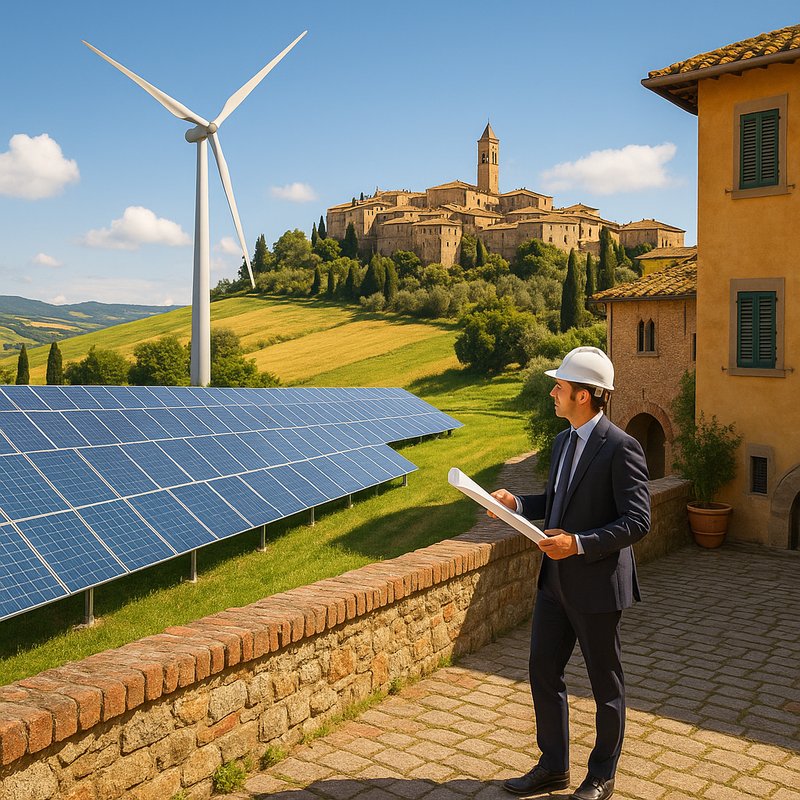
On September 21, 2017, Italy launched its National Energy Strategy (SEN), a ten-year roadmap to reshape the country's energy future. You'll find it targets 28% of total energy consumption from renewables by 2030, with solar PV tripling output to 72 TWh and wind rising to 40 TWh. Backed by EUR 180 billion in total investment, it's an extensive plan—and there's much more to uncover about how Italy intends to get there.
Key Takeaways
- Italy launched its National Energy Strategy (SEN) in 2017, targeting 28% renewables in total energy consumption by 2030.
- The strategy allocates EUR 35 billion specifically for renewable energy development, with total energy sector investment reaching EUR 180 billion.
- Solar PV output must triple from 23 TWh to 72 TWh, requiring solar to account for 50% of new installations.
- Wind energy generation targets an increase from 25 TWh to 40 TWh, demanding significant capacity additions through 2030.
- Investment mechanisms including feed-in tariffs, feed-in premiums, and competitive auctions are designed to attract private renewable energy capital.
What Is Italy's National Energy Strategy and Why Does It Matter?
Italy's National Energy Strategy (SEN), launched in 2017, sets a ten-year roadmap to make the country's energy system more competitive, sustainable, and secure.
It's Italy's clearest signal yet that the country is committed to a meaningful energy shift.
The strategy directly shapes investment decisions, regulatory frameworks, and technology priorities across the sector.
It targets a 28% renewables share in total energy consumption by 2030 and cuts final energy use by 10 Mtoe.
These aren't abstract goals—they're benchmarks tied to Italy's broader climate goals under international agreements.
If you're tracking Italy's energy market, the SEN matters because it defines where capital flows, which technologies receive support, and how quickly fossil fuels lose ground.
It's the policy foundation driving everything that follows.
What Does the 2030 Renewable Energy Target Actually Require?
Hitting Italy's 2030 renewable energy targets means clearing some specific and demanding benchmarks.
You're looking at renewables reaching 28% of total energy consumption and 55% of electricity consumption by 2030. That jump underscores the renewable energy importance driving Italy's entire policy agenda.
To get there, solar PV output must climb from 23 TWh to 72 TWh, while wind rises from 25 TWh to 40 TWh.
Hydroelectric stays roughly flat at 50 TWh, meaning solar and wind carry most of the growth burden.
These numbers make the energy evolution challenges concrete — you can't meet them through incremental steps.
Italy needs aggressive capacity additions, sustained investment, and competitive auction mechanisms that consistently attract developers willing to build greenfield renewable projects at scale.
How Much Solar and Wind Capacity Does Italy Need to Build?
Reaching 72 TWh from solar PV alone means Italy must roughly triple its current output — a buildout that demands solar account for about 50% of newly installed capacity through 2030.
That's an enormous solar capacity expansion you can't underestimate. Wind capacity must also grow, with projections pushing wind generation from 25 TWh to 40 TWh by 2030.
While wind's growth looks modest compared to solar's leap, it still requires consistent investment and permitting momentum. Italy's hydroelectric output stays relatively flat at 50 TWh, so solar and wind carry the heaviest load in hitting the 55% renewables-in-electricity target.
You're looking at a decade-long construction push that needs aligned incentives, grid upgrades, and competitive auctions delivering real results — not just targets on paper.
What Does Italy's Coal Phaseout Mean for the Power Mix?
Coal's exit from Italy's electricity grid by 2025 closes off a major chunk of dispatchable generation — and that gap doesn't fill itself. The coal phaseout implications reach across the entire power mix evolution, forcing a faster shift toward renewables, gas infrastructure, and smarter grid management.
You'll see hydroelectric output hold steady at roughly 50 TWh, offering baseline reliability, but it won't absorb coal's full contribution.
That's where solar PV and wind step in, with generation targets climbing to 72 TWh and 40 TWh respectively by 2030.
Italy's strategy also leans on expanded gas and electricity networks, backed by roughly €30 billion in planned investment.
Eliminating coal isn't just an environmental move — it fundamentally restructures how Italy generates, distributes, and balances its electricity supply.
Where Does the EUR 180 Billion in Renewable Investment Come From?
Restructuring Italy's power mix on that scale requires serious capital — and that's where the EUR 180 billion investment figure enters the picture. The SEN expects private investors to drive most of this funding through targeted incentives and competitive auctions.
Here's how the investment sources break down:
- EUR 35 billion directed toward renewable energy sources
- EUR 110 billion allocated for energy efficiency improvements
- EUR 30 billion supporting networks and gas-electricity infrastructure
The funding mechanisms behind these figures aren't government handouts — they're structured incentives designed to pull private capital into greenfield projects.
Feed-in tariffs, feed-in premiums, and auction-based support all play a role. You're looking at a system built to make clean energy investment financially attractive while keeping public spending disciplined.
How Do Italy's Incentive Schemes and Auctions Actually Work?
How Italy channels EUR 180 billion in private capital comes down to three core mechanisms: feed-in tariffs, feed-in premiums, and competitive auctions. These incentive mechanisms determine how much support your project receives and under what conditions.
Feed-in tariffs guarantee a fixed payment per kilowatt-hour, while feed-in premiums top up market revenues. Both reduce your revenue risk considerably. For solar PV, incentives can cover up to 60% of capital costs. Wind, solar thermal, and biomass projects can access up to 30%.
Auction dynamics add a competitive layer. You submit bids through registries and auctions, competing against other developers for allocated support. This approach drives down costs while directing capital toward greenfield projects.
Technologies like biomass and hybrid plants also receive preferential treatment in dispatching rules.