

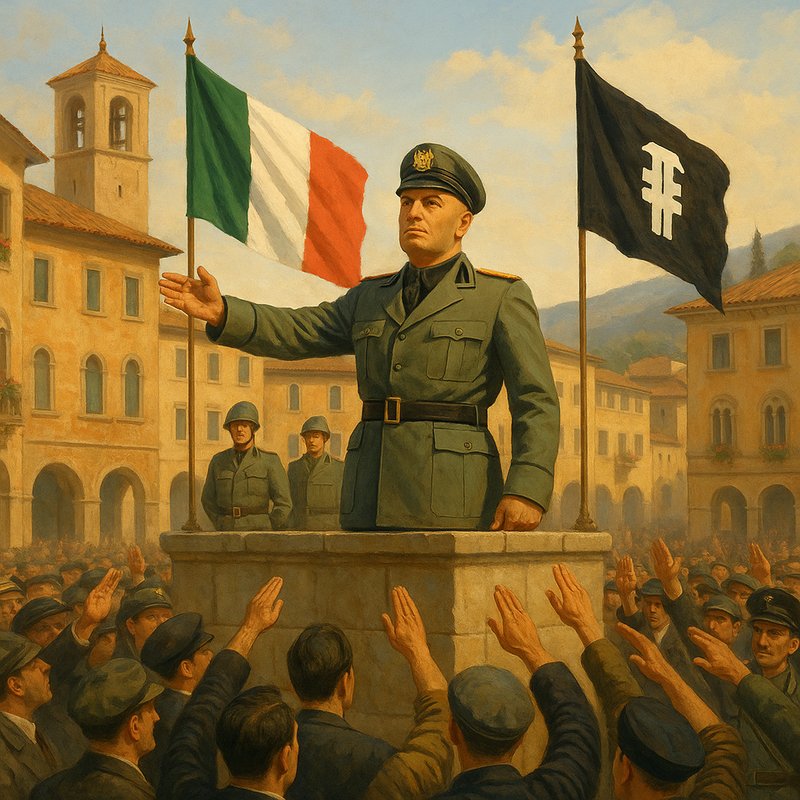
On September 23, 1943, Mussolini formally established the Italian Social Republic, also called the Salò Republic, after Hitler rescued him from Italian captivity. You should know this wasn't a truly independent state — Germany held all real power, making Mussolini little more than a figurehead. The republic lasted less than 19 months before collapsing under partisan resistance, Allied pressure, and Mussolini's execution in April 1945. There's far more to this fascinating story ahead.
Key Takeaways
- On September 23, 1943, Mussolini formally established the Italian Social Republic (Repubblica Sociale Italiana) under German support following his rescue by Hitler.
- The republic emerged after the Italian Armistice of Cassibile collapsed Mussolini's original government, triggering German military occupation of Italy.
- Hitler announced the new state's formation via a Munich radio broadcast, installing Mussolini as leader of the Nazi-backed puppet state.
- Despite claiming authority over all Italy, Mussolini was a figurehead; true power belonged to the Wehrmacht and Nazi Germany.
- The republic operated from Salò, not Rome, as Allied control prevented Mussolini's government from establishing itself in the capital.
What Made the Italian Social Republic a Fascist Puppet State
When Germany occupied northern Italy in 1943, it didn't just create a power vacuum—it filled one with Benito Mussolini. Hitler personally engineered Mussolini's return to power, making the Italian Social Republic's dependence on Nazi Germany undeniable from day one.
You can see the puppet dynamics clearly in how the regime actually functioned. Mussolini claimed authority over all of Italy and its colonies, yet he controlled only what German forces allowed him to control. Wehrmacht troops held the real power.
Fascist propaganda kept the illusion of Italian sovereignty alive, but the regime's survival hinged entirely on German military support. Without Hitler's intervention, the Italian Social Republic wouldn't have existed. That's not independence—that's a regime operating on borrowed legitimacy and foreign bayonets.
The Italian Armistice That Gave the Salò Republic Its Opening
The puppet state didn't emerge from nothing—it needed a crack in Italy's existing structure first. The Italian Armistice of Cassibile shattered the original Fascist regime, splitting the country and creating the opening Germany exploited.
Here's what that sequence looked like:
- Italy signed the armistice, collapsing Mussolini's first government
- Germany immediately occupied northern Italy militarily
- Hitler intervened directly, rescuing Mussolini and restoring him to power
- Mussolini's Reaction led to a radio broadcast from Munich announcing the new state
You can trace the Salò Republic's entire existence back to that single fracture point.
Without the armistice triggering Germany's occupation, there's no rescue, no Mussolini comeback, and no Italian Social Republic proclaimed on September 23, 1943.
How Germany Restored Mussolini to Power in Occupied Italy
Hitler didn't just support Mussolini's return—he engineered it.
After Italian King Victor Emmanuel III had Mussolini arrested in July 1943, Nazi intervention became the defining force that reversed his fall. German special forces rescued Mussolini from captivity in a dramatic raid, and Hitler personally guaranteed his former ally reclaimed a leadership role.
You'd be wrong to call it a genuine restoration, though. Mussolini didn't return to power on his own terms—he returned on Germany's.
The Wehrmacht controlled northern Italy militarily, and without that occupation, there'd have been no platform for him to govern from at all. Nazi intervention transformed a deposed dictator into a functional figurehead, giving Germany a compliant Italian administration to manage occupied territory while the war continued pushing northward.
The Radio Broadcast That Created the Italian Social Republic
On 23 September 1943, Mussolini stepped before a Munich radio microphone and announced the birth of a new fascist state. Through this radio announcement, he reclaimed authority over German-occupied northern Italy.
Mussolini's rhetoric framed the moment as a resurrection of Italian fascism, not a defeat.
The broadcast covered four key points:
- The proclamation of the Repubblica Sociale Italiana
- Mussolini's reassertion of leadership as head of state
- A sovereignty claim over all Italian territories and colonies
- A renewed commitment to the Axis alliance with Nazi Germany
You can trace the regime's entire identity back to that single broadcast.
Without it, no formal state existed. The microphone in Munich effectively created the Italian Social Republic before any government structure was in place.
Why Mussolini's Government Operated From Salò, Not Rome
Why did Mussolini's government never set up in Rome? Simply put, the Allies controlled the south, and Rome sat too close to the front lines. German forces held northern Italy, so Mussolini's relocation to the north wasn't optional — it was a military reality.
Salò significance came down to geography and security. The small town on Lake Garda offered a defensible, centrally accessible base within German-occupied territory. Most government ministers settled nearby, the regime's press communications flowed from there, and the town effectively became the republic's operational heart.
You can think of it this way: Rome remained the symbolic capital on paper, but Salò ran the actual government.
That disconnect between claimed authority and real control defined the entire republic's fragile, dependent existence.
Who Actually Controlled the Italian Social Republic?
Although Mussolini held the titles of head of state and prime minister, Nazi Germany's military presence made him a figurehead in practice. When you examine Italian governance under the Republic, German influence shaped nearly every decision. Real control rested firmly with Berlin, not Salò.
Here's what that looked like on the ground:
- Wehrmacht forces occupied all northern Italian territory.
- Germany installed and sustained Mussolini after rescuing him.
- Partisan resistance undermined any stable Italian governance.
- Diplomatic recognition came only from Axis-aligned states.
You can see that Mussolini's authority existed largely on paper. German influence dictated military operations, territorial boundaries, and political survival.
Without Hitler's direct intervention, the Italian Social Republic wouldn't have functioned at all.
The Territory the Italian Social Republic Really Held
Everything Mussolini claimed to govern far exceeded what his regime actually held. The Italian Social Republic asserted authority over all of Italy and its colonies, but the territorial limits of its real control told a completely different story.
You'd find that German military forces occupied and effectively ran northern Italy, leaving Mussolini's government dependent on Wehrmacht presence to function at all.
Rome remained the formally claimed capital, but you wouldn't find the regime operating there. Instead, leaders concentrated in Salò and other northern capitals scattered across the Lake Garda region.
Allied forces controlled the south, and partisan resistance further destabilized the north. What Mussolini publicly declared as a sovereign state was, in practice, a narrow German-occupied strip that grew smaller as Allied forces advanced northward.
How Partisan Fighters Undermined the Salò Republic From Within
Partisan fighters didn't just resist the Salò Republic from the margins—they actively dismantled its ability to govern from within. Through coordinated internal resistance, they exposed how fragile Mussolini's final regime truly was.
Their partisan strategies targeted key vulnerabilities:
- Sabotaging supply lines feeding German and RSI military operations
- Assassinating Fascist officials to paralyze local administration
- Organizing strikes that crippled industrial output in northern cities
- Distributing underground propaganda to erode public loyalty
You can see how these efforts compounded the regime's instability. The Salò Republic couldn't consolidate control because resistance fighters continuously disrupted its infrastructure and authority.
Partisan pressure, combined with German military dependence, guaranteed the republic never functioned as a legitimate, stable state before its collapse in April 1945.
How the Italian Social Republic Collapsed in April 1945
By April 1945, the Salò Republic was unraveling fast. Allied forces were pushing north, partisan fighters controlled entire regions, and Nazi influence had become the only thing keeping the regime alive.
Without German military backing, Mussolini's government had no real power, no stable territory, and no path forward.
You can trace the collapse to April 25, 1945, when northern Italy was liberated and the regime officially fell. Mussolini attempted to flee toward Switzerland, but partisans intercepted him near Lake Como.
Mussolini's capture on April 27 ended any remaining pretense of Fascist authority. He was executed the following day.
German troops in Italy surrendered on May 2, 1945, drawing a final close to nearly 19 months of puppet-state rule under Mussolini.