

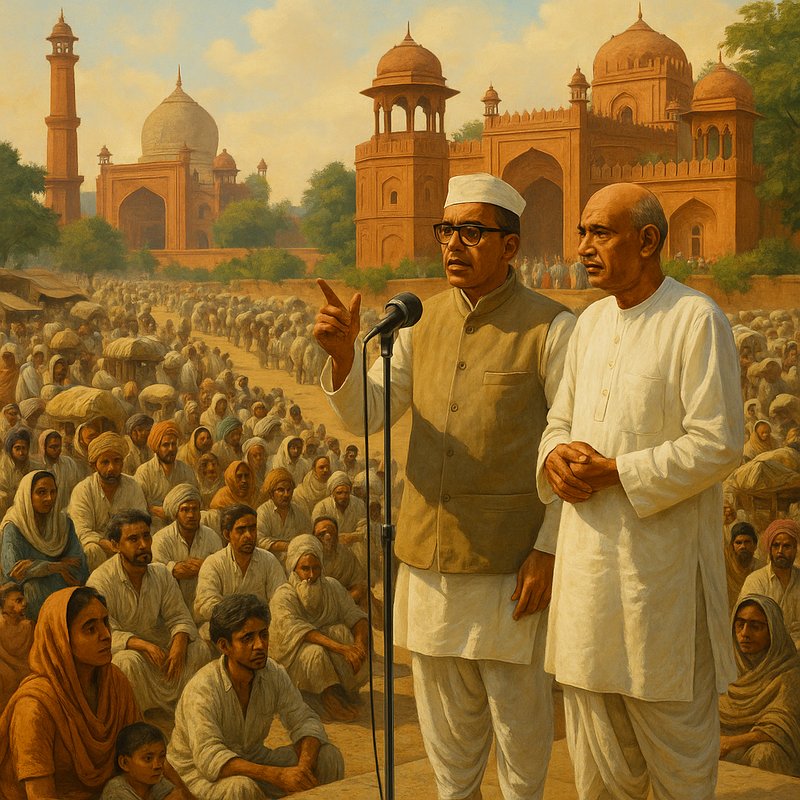
On September 21, 1947, you're looking at one of history's most staggering humanitarian disasters, as Indian leaders scrambled to address a refugee crisis that had already swallowed millions of lives. Between 10 and 20 million people were displaced, with convoys stretching over 60 miles. Nehru and Patel publicly condemned violence, defended vulnerable populations, and admitted the government wasn't prepared. What they did next would shape the legal and political future of both nations.
Key Takeaways
- By September 1947, displacement had reached crisis levels, with over 1 million crossings recorded between August 17 and September 7 alone.
- Nehru and Patel actively addressed communal violence, advocating for protection of vulnerable populations amid overwhelming humanitarian challenges.
- Patel urged Sikh volunteers in Amritsar to protect Muslim refugees, condemning civilian retaliation as a "mad man's dream."
- Both governments faced severe shortages in camps, food, and transportation, with administrative capacities stretched dangerously thin.
- Nehru criticized foreign press misrepresentation of communal violence, pushing for a comprehensive, balanced understanding of the crisis.
The Scale of Displacement: What India Faced in September 1947
By the time India and Pakistan formally came into existence on 14–15 August 1947, they'd already inherited a crisis neither government had fully prepared for. You're looking at displacement dynamics that defied early estimates, with between 10 million and 20 million people uprooted almost immediately. Muslims moved toward Pakistan while Hindus and Sikhs crossed into India, creating simultaneous, massive flows across a newly drawn border. By 12 September, Nehru confirmed that 1.25 million people had crossed from West Punjab to East Punjab alone, with a similar number moving the other direction. The humanitarian response struggled to keep pace. Train routes turned deadly, foot convoys stretched over 60 miles, and both governments faced acute shortages in camps, food, and transport infrastructure.
How Many Refugees Were Displaced by Partition?
The numbers behind Partition's displacement are staggering, and they're worth examining closely. When British India split into two independent dominions on August 14–15, 1947, it triggered one of history's largest forced migrations. Refugee statistics vary widely, but estimates place the total displaced population between 10 million and 20 million people.
Migration patterns followed religious lines. Muslims moved toward Pakistan, while Hindus and Sikhs moved toward India. By mid-September 1947, Nehru confirmed that 1.25 million people had crossed from West Punjab to East Punjab alone, with a similar number moving in the opposite direction. Official frontier records counted over one million crossings between August 17 and September 7. Communal violence compounded the crisis, with death estimates reaching up to two million people.
The 300,000-Person Refugee Convoy That Stretched 60 Miles
Among the most staggering images of Partition's upheaval is a single refugee convoy that stretched more than 60 miles and carried almost 300,000 people, mostly Sikhs, moving on foot toward safety. If you imagine standing at one end, you couldn't see where it began or ended. These refugee journeys weren't orderly migrations—they were desperate movements through corridors where attacks remained a constant threat. Train and road routes turned deadly as communal violence followed the displaced across the new borders. The humanitarian response from both governments struggled to match the scale of need, with camp shortages and emergency relief stretched thin. This convoy alone represented a crisis that no administration had adequately prepared for, as Nehru himself later admitted publicly.
Nehru Admits the Government Was Caught Off Guard
But Nehru didn't stop at self-criticism. He also pressed the issue of media responsibility, pushing back against foreign press outlets he felt were unfairly pinning the violence and disorder on Sikhs alone.
You're watching a new government publicly reckon with its own limitations—acknowledging that millions of people had moved across a border its leaders weren't ready to manage.
Nehru's Defense of Sikhs and His Attack on Foreign Press Coverage
Nehru's press conference didn't end with self-criticism—he turned outward, taking direct aim at foreign press outlets he believed were misrepresenting the crisis. In Nehru's Critique, he pushed back against international reporting that placed blame squarely on Sikhs for the violence and disorder sweeping the region. He felt that framing was both unfair and dangerously incomplete.
You have to understand the context of Sikh Muslim Relations during this period—decades of shared geography, now fractured by Partition's sudden borders and communal bloodshed. Nehru argued that singling out Sikhs ignored the full picture of retaliatory violence happening on multiple sides. He wanted accountability applied evenly, not wielded selectively by foreign journalists who, in his view, lacked the ground-level understanding the crisis demanded.
Patel's Amritsar Address and the Call to Protect Muslim Refugees
While Nehru was fielding press questions in New Delhi, Sardar Patel took his message directly to the streets. On September 30, 1947, he addressed more than 200,000 people in Amritsar, laying out Patel's principles on refugee protection with striking clarity.
He called retaliation a "mad man's dream" and urged Sikh volunteers to shield Muslim refugees from attack. He didn't mince words: fighting against displaced civilians was "no fight at all." He reminded the crowd that no law of humanity or war permitted the slaughter of people seeking shelter.
You can see how Patel framed refugee protection not as charity but as a basic moral obligation, pushing back hard against the cycle of communal violence consuming the region.
Why Indian Leaders Rejected Retaliation as a "Mad Man's Dream"
Retaliation, in Patel's view, wasn't strength—it was delusion. He called it a "mad man's dream," warning you that striking back against Muslim refugees wouldn't restore order—it would deepen chaos. The retaliation consequences weren't abstract. Violence against displaced civilians strained resources, inflamed tensions, and undermined the new government's legitimacy at its most fragile moment.
Both Patel and Nehru understood that a humane response wasn't just morally right—it was politically necessary. You couldn't build a functioning state while mobs attacked people seeking shelter. Nehru had already admitted the government was caught unprepared. Patel reinforced that message in Amritsar, standing before 200,000 people and demanding they reject vengeance. Leadership, they argued, meant protecting the vulnerable, not punishing them for the religion they carried across the border.
How Partition Strained Housing, Food, and Finances Across Both Dominions
The scale of displacement didn't just create a humanitarian emergency—it broke the practical systems holding both dominions together. Millions of arrivals overwhelmed available shelter, creating acute housing shortages in cities and towns unprepared for sudden population surges. Food scarcity followed quickly, as supply chains couldn't absorb the demand from displaced populations flooding refugee camps.
The financial strain hit both governments hard. India's Treasury alone spent the equivalent of $67 million in 1950 prices on refugee camps between 1947 and 1950. Emergency relief operations consumed state resources at a pace neither dominion had anticipated. Transport networks buckled, administrative capacity stretched thin, and early government responses struggled to keep pace. The crisis forced both India and Pakistan to improvise solutions under enormous pressure.
The Laws India and Pakistan Passed to Rehabilitate Partition Refugees
Both dominions eventually moved from emergency improvisation to formal legal frameworks. As you examine the rehabilitation policies each government adopted, you'll see structured attempts to address displacement's lasting consequences.
Here's what each country enacted:
- India passed the Displaced Persons (Legal Proceedings) Act in 1949 to resolve post-Partition claims
- Pakistan issued a property ordinance in 1950, followed by the Displaced Persons (Compensation and Rehabilitation) Act in 1958
- Nehru and Liaquat Ali Khan signed an April 1950 agreement letting migrants return home and recover property
- Nehru promised to help refugees from both sides reclaim their homes
These legal frameworks didn't erase the trauma, but they gave displaced families concrete mechanisms to pursue compensation, property recovery, and some measure of stability.
The Nehru–Liaquat Pact and the Right to Return
Signed in April 1950, the Nehru–Liaquat Pact gave displaced families on both sides of the border a formal right to return home and recover their property. The Nehru Liaquat agreement directly addressed refugee rights by committing both governments to protect minorities and allow migrants to reclaim what they'd lost. If you'd been forced from your home during Partition, this pact offered you a legal path back. Nehru also publicly promised to do everything possible to help refugees on both sides return. The agreement didn't erase the trauma of displacement, but it established a political framework that acknowledged your right to property and safety. It marked a shift from emergency crisis management toward longer-term accountability between the two new nations.