
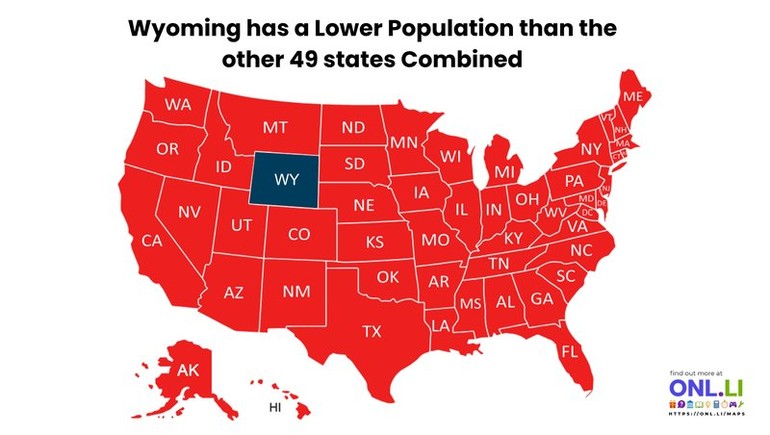
Wyoming is America's least populous state, with fewer than 600,000 residents despite covering more than 97,000 square miles. While it ranks among the country's largest states by land area, its wide-open landscapes, mountain ranges, and vast public lands have kept its population remarkably small compared to the rest of the nation. United States | Population and Demographics
Although the statement on this map is technically true—Wyoming's population is smaller than the combined population of the other 49 states—it highlights just how unevenly Americans are distributed across the country. Nearly every other state contains millions of residents, while Wyoming remains one of the nation's most sparsely populated places.
Why Wyoming Has So Few Residents
Several factors have contributed to Wyoming's small population. Much of the state consists of rugged mountains, high plains, forests, and federally protected land, limiting large-scale urban development. Long winters, relatively isolated communities, and limited agricultural land have also influenced settlement patterns throughout its history.
Unlike neighboring Colorado or Utah, Wyoming never developed multiple large metropolitan areas. Instead, its residents are spread among small cities, towns, ranches, and rural communities separated by long stretches of open land.
Vast Land, Very Few People
Despite being the tenth-largest U.S. state by area, Wyoming has the lowest population density in the country. On average, only a handful of people occupy each square mile, creating enormous expanses of undeveloped wilderness.
Much of the state is managed by federal agencies, including national forests, Bureau of Land Management lands, and famous national parks such as Yellowstone and Grand Teton. These protected landscapes preserve Wyoming's natural beauty while also limiting large-scale residential expansion.
A Resource-Based Economy
Wyoming's economy relies heavily on energy production, mining, ranching, agriculture, and tourism rather than large manufacturing or technology industries. Coal, natural gas, oil, and trona have long been major economic drivers, while millions of visitors arrive each year to experience the state's national parks and outdoor recreation.
Because many industries require relatively small workforces spread across large geographic areas, population growth has remained modest even during periods of economic expansion.
Small Population, Full Representation
Although Wyoming has the fewest residents of any state, it still enjoys equal representation with every other state in the U.S. Senate, electing two senators. In the House of Representatives, however, it has only one at-large congressional district because of its small population.
Its low population also means residents often enjoy shorter commutes, less traffic congestion, and easy access to outdoor recreation. At the same time, maintaining roads, utilities, schools, and healthcare services across such a vast area presents unique challenges.
A State Defined by Open Spaces
Wyoming's identity has long been shaped by its wide-open landscapes rather than crowded cities. From the Bighorn Mountains to Yellowstone National Park, much of the state remains remarkably undeveloped compared to other parts of the United States.
Maps like this illustrate that population isn't always tied to land area. Wyoming covers an enormous portion of the American West, yet its residents make up only a tiny fraction of the nation's total population.